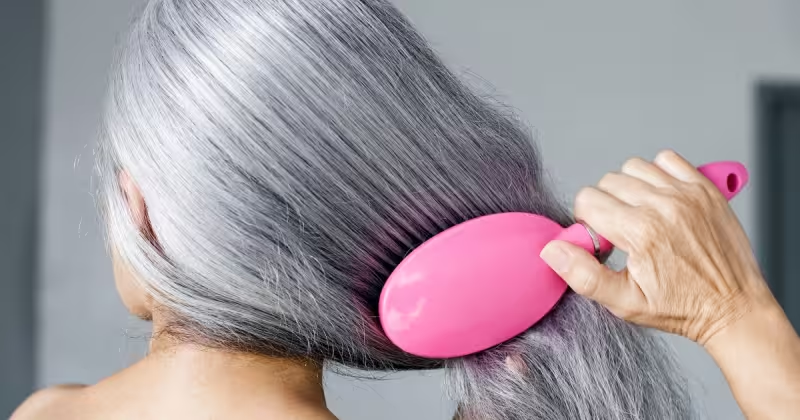
Grey hair is a fact of life, and dermatologists say the products promising to turn it back are not living up to the pitch. Despite a 280% jump in U.S. online search interest for anti-gray hair serums over the past year, experts say there are no products that definitively reverse gray hair.
That leaves shoppers trying serums and supplements with plenty of marketing and very little proof. Some products promise to reduce the appearance of grays, renew color and show visible results in a few months when used every day, but specialists say the science does not back a guaranteed reversal.

The reason is rooted in how hair gets its color in the first place. Dr. Mona Gohara said hair follicles contain pigment-producing factories called melanocytes that give hair its color, and Dr. Jonathan Zippin said graying happens mostly because those cells are no longer renewing. Melanocytes live at the midpoint of the hair and migrate to the base of the follicle when they need to replicate and produce pigment. When they stop moving and populating the bottom of the hair, the strand can appear gray. If there are no melanin-producing cells at the base, the hair looks gray; if there are none at all, it turns white.



Hair usually starts to lose color over time in the 30s or 40s, though the age at which it begins and how much turns gray or white varies by person. Gohara said genetics likely play a role, and Zippin said stress may also contribute. Studies in mice suggest stress can damage melanocytes and make hair turn gray, and a 2021 study found stress can do the same in humans. That same study found that taking away stress appeared to reverse the process and allow white strands to return to their natural color at the root, but the effect was temporary, limited to a certain age group and seen in only a few follicles.
That small window is the part that keeps the gray-hair reversal idea alive. But it is not the same as a product that can restore color on command. Zippin said some medicines can also affect or stress melanocytes and lead to gray hair, adding another reason the process varies so much from person to person. Gohara put it plainly on a TODAY segment aired Aug. 2: “Sometimes the melanocytes get tired. They just don’t want to work anymore.”
For now, the answer for people chasing a cure is straightforward: gray hair can be understood, and sometimes it can even be temporarily shifted under unusual conditions, but no serum or supplement has been shown to reverse it definitively. What remains unresolved is whether future studies will find a treatment that works in humans better than the current marketing does.