



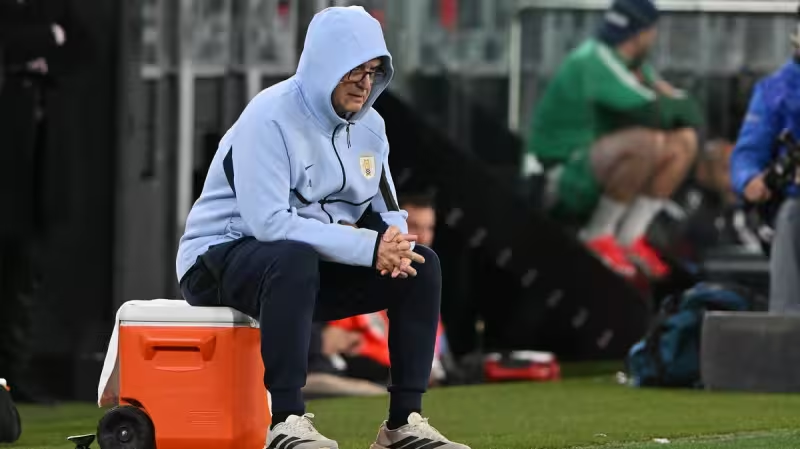
“You want me to tell you more than what it is? It's just a bucket. I have nothing to add. It's a comfortable bucket,” Marcelo Bielsa said, and the image is already set: the 70‑year‑old manager perched on a plastic seat at the edge of the pitch as Uruguay head to the World Cup.
Bielsa, unveiled as Uruguay’s manager in May 2023 and only the second foreign trainer in the country’s history, will lead the side at a World Cup for the third time in his career. He guided Uruguay through qualification and arrives in Miami preparing for the opening match against Saudi Arabia at Miami Stadium on Monday, June 16.

The bucket is no small piece of theatre. It followed a stint sitting on a cooler box while at Marseille and became a defining prop during his time in England, where observers first noticed it and a copy sold out in the Leeds United club shop. The sight of Bielsa away from the dugout, low to the ground, has been as recognisable to supporters as the systems he trains his teams to run.

There is, however, more than habit in the image. In a documentary last year, Guillem Balague noted practical reasons behind Bielsa’s routine: “He [Bielsa] walks the four miles from his home to the training ground,” and Balague added that Bielsa’s walking and his frequent crouches on what looks like a plastic bucket are a way of coping with “constant back pain that has not left him since his time as a player.” Bielsa, by contrast, has repeatedly downplayed any symbolism, insisting the seat is simply comfortable.
That tension — between a man who insists it is nothing and observers who read a deeper method to the movement — has produced some pointed reactions from other coaches. Paul Warne, watching Bielsa in action, admitted the bucket made him feel “a little nervy,” calling the sight “a bit weird” but also confessing he admired the simplicity: “oh, he's copying him!” and “But his looks more comfortable than my ice box. It's a class bit of kit that. I'm pretty impressed.”
Bielsa’s sideline habits travel with him. He first led Argentina to the 2002 World Cup and then took Chile to South Africa in 2010, and the bucket has threaded through the later chapters of a career that returned him to South American international management in 2023. For Uruguay supporters, the image is both familiar and loaded: a practised, exacting coach whose small physical choices have become part of how a team is read before the first whistle.
What matters now is immediate and visible. Uruguay’s players and followers will not have to wait long to see whether Bielsa keeps his seat at the touchline; the team’s meeting with Saudi Arabia in Miami on Monday, June 16, will answer that plainly. More than a quirk, the bucket has come to symbolise how Bielsa manages — the body and the details — and whether he leaves it on the sideline for the group stage will be one of the season’s smallest, most telling decisions.



