




Uruguay begin their 2026 FIFA World Cup Group H campaign on Monday when they meet Saudi Arabia in the opening fixture for the group.
The match matters because it is the first competitive step for two sides with very different recent World Cup pedigrees: Uruguay arrive for their 15th World Cup after finishing fourth in Conmebol qualifying and carry the weight of being two-time champions (1930, 1950), while Saudi Arabia make a seventh appearance and a third straight trip after topping Group B in the AFC fourth round.

Numbers underline the stakes. The 2026 World Cup runs June 11–July 19 across 16 cities in the United States, Canada and Mexico in an expanded 48-team format that sends the top two teams from each group and the top eight third-place finishers into the knockout phase. An opening result here will shape a group where small margins can decide who advances under the new structure.
Uruguay arrive managed by Marcelo Bielsa, the high-profile coach who previously led Argentina at the 2002 World Cup and Chile at the 2010 tournament. His squad lists established internationals such as Real Madrid midfielder Federico Valverde and Atlético Madrid center back José María Giménez. Juan Manuel Sanabria is in the mix for a World Cup debut — he has five previous caps and arrives off a breakthrough club season that produced six assists in 11 MLS appearances for Real Salt Lake.
Saudi Arabia will not be underestimated. Salem Al-Dawsari returns as captain. RC Lens right back Saud Abdulhamid and Al-Ahli striker Feras Al-Buraikan, who scored five goals during qualifying, are among the players expected to carry Saudi threats. The Saudis also bring momentum from Qatar 2022, where they stunned the tournament by beating eventual champions Argentina 2-1 — a result that complicates any assumption this opener will be straightforward for Uruguay.
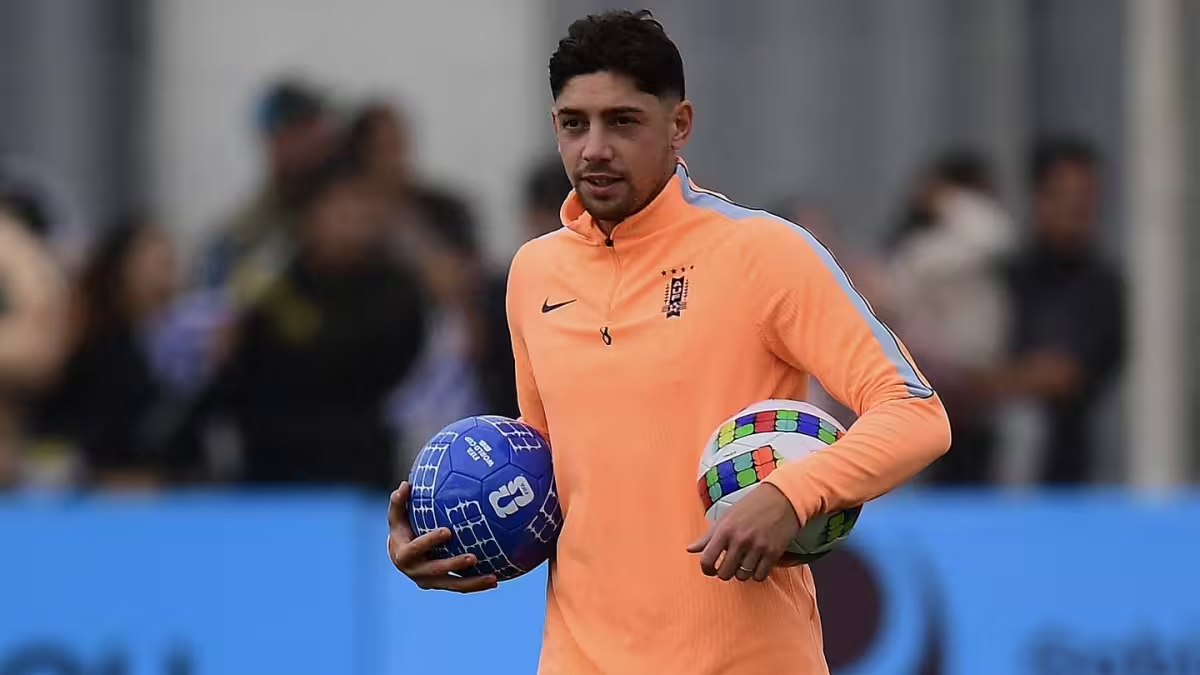


The tactical matchup frames the core questions for Monday. Uruguay will want to control midfield through Valverde and protect a back line marshalled by Giménez; Saudi Arabia will look to test space in transition, using Abdulhamid down the flank and Al-Dawsari’s leadership in attack. How Bielsa lines up his midfield against a compact, counter-minded Saudi side is the key unresolved selection decision heading into kickoff.
Practical details matter for what to watch when the game begins. An early goal would force either manager to alter plans quickly, because neither side can treat this opener as a mere warm-up in a compressed group where advancing can hinge on goal difference and third-place tiebreakers. Discipline and set-piece defending will also be decisive — qualifiers and recent tournaments have shown both teams can be vulnerable in those moments.
The friction in this match is straightforward: Saudi Arabia’s 2-1 win over Argentina at Qatar 2022 proves they can produce upset results on the biggest stage, and Uruguay’s status as two-time champions does not erase the practical uncertainty of tournament football. That contradiction turns selection and match tempo into the matchup’s true battle lines.
What comes next sharpened by Monday’s result: Uruguay’s remaining group fixtures are against Cape Verde on June 21 and Spain on June 26. Saudi Arabia close out their group with a match against Spain on June 21 and Cape Verde on June 26. How Bielsa fields Uruguay against Saudi Arabia will influence whether his side approaches the Spain game as a must-win or as a chance to rotate.
The simplest watch-point for viewers: if Uruguay can impose midfield control without conceding counter chances, they will leave Monday with the advantage. If Saudi Arabia recreate Qatar 2022’s clinical edge on the break, Group H suddenly becomes open. Either way, the match will set the tone for three weeks of group play under the new 48-team World Cup format.



