



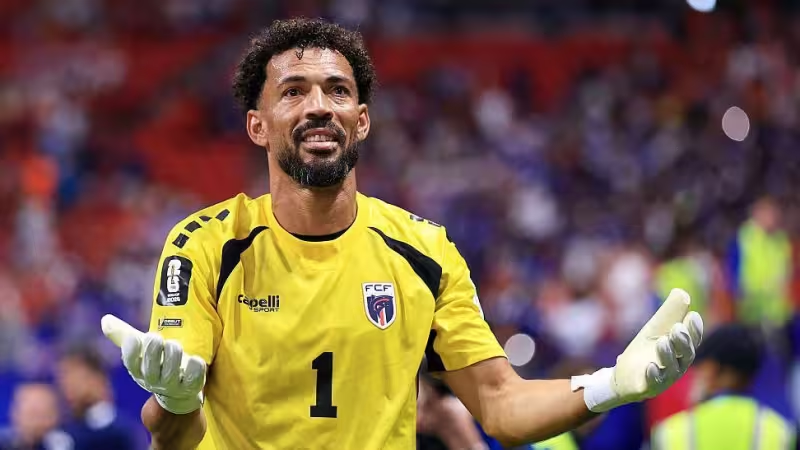
When Josimar José Évora Dias was a boy in São Vicente he says he would come home bruised from street football and crawl into his grandmother’s arms — and the nickname that stuck, vozinha, came from that habit. On June 15, 2026, that nickname will be on the team sheet as the 40-year-old goalkeeper starts Cabo Verde’s first-ever World Cup match, against Spain in Atlanta.
The match is the high mark of a career that has made him one of the nation’s most recognizable figures: going into the opener he had 90 appearances for Cabo Verde, second only to Ryan Mendes’s 96, and he is among the oldest players on the tournament rosters. He first received a call-up in 2012, has played in four editions of the Africa Cup of Nations and is widely credited with helping the island nation finish top of its qualifying group ahead of Cameroon to reach the 2026 World Cup.

Vozinha’s story is stitched from small details that travel well on a big stage. His given name, Josimar, was a tribute from his father to Josimar Higino Pereira — the Brazilian who played in the 1986 World Cup and later became a Botafogo reference point — and he left Cabo Verde early in his career still using that name. He later adopted vozinha after discovering another goalkeeper named Josimar in Angola and, as he put it, the nickname took hold.
On club résumés he is well-traveled: Batuque and Mindelense at home, Progresso and a stint in Angola, Zimbru Chisinau, AEL Limassol, AS Trencin, Gil Vicente and a move to CD Chaves in 2024 after Hugo Souza’s loan returned to Brazil. Those stops trace a long professional life, but the tournament has also focused attention on an awkward fact — at the time of recent coverage his contract with CD Chaves had ended and he was listed as without a club.
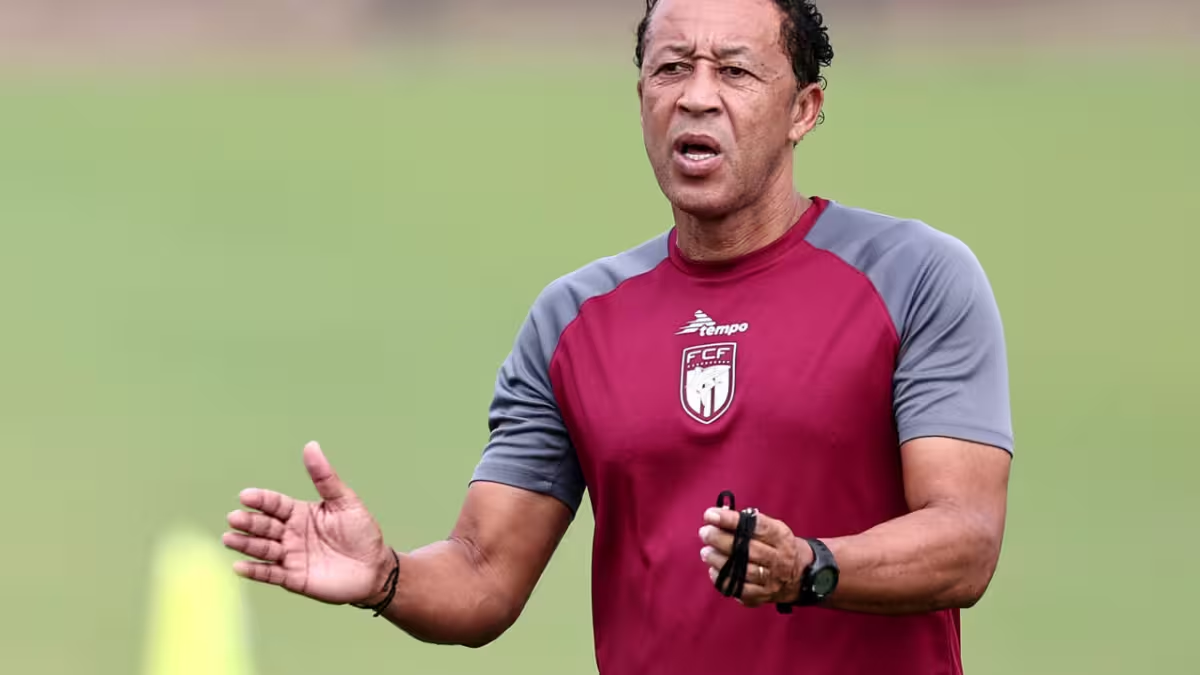
That gap undercuts a tidy narrative. Here is a veteran who captains a historic campaign for Cabo Verde and who has been presented as a symbol of continuity and experience, yet he goes into the World Cup without the security of a current club contract. It is a practical question — where will he play next — and it is also a story about what national duty can do to a player’s market value late in his career.
On the field, though, Vozinha’s place is straightforward: coach and fans expect him to marshal the goal for Group H, which pairs Cabo Verde with Spain, Uruguay and Saudi Arabia. The calendar hands him two immediate chances to reinforce the story the nation wants told — a meeting with Uruguay on June 21 and Saudi Arabia on June 26 — and every game will be measured against that opener with Spain.
For supporters who grew up hearing that he ‘‘never lived with his parents’’ because his father was in military service and his mother worked, the image of the small boy running back to his grandmother has become a shorthand for resilience. The tournament will show whether resilience alone is enough to carry a 40-year-old keeper through the rigors of group play and to persuade a club to sign him for whatever comes after the World Cup.
The immediate fact is simple and precise: Vozinha will stand between the posts in Atlanta on June 15 and then travel with Cabo Verde for two more Group H matches. The sharper question — the one likely to shape the next chapter of his life — is off the pitch: will this World Cup start be followed by a new club contract, or will the goalkeeper who helped qualify his country for its first World Cup close this chapter as a free agent? The answer will arrive in the days after the opener, when performances and offers collide.



