A few days ago Dr. Andreu Martínez published an Instagram entry aimed squarely at Marcos Llorente's recent remarks on sun exposure, sunscreen and other lifestyle choices, posting under the headline: "Marcos Llorente, sol, chemtrails y biohacking: ¿qué dice realmente la ciencia?" The message, visible to his more than 27,000 followers, arrived after two public appearances by Llorente on El Hormiguero and El Partidazo de COPE.
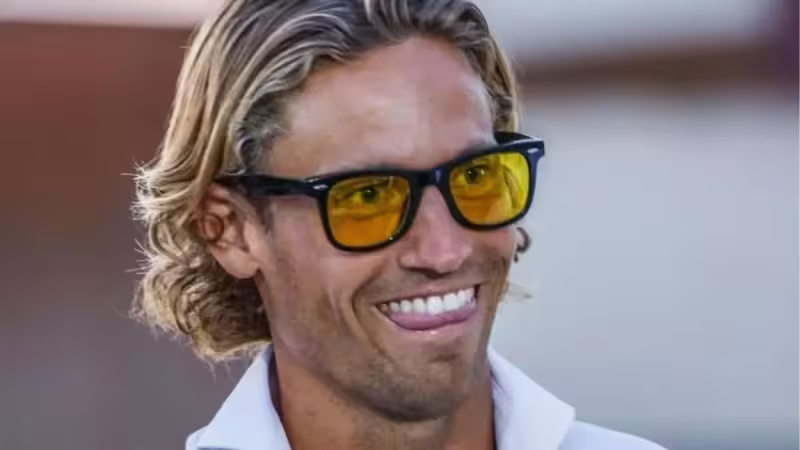
On those programs Llorente defended avoiding sunscreen, said he wears yellow sunglasses outdoors and red ones indoors, and affirmed he follows a strict Paleolithic diet. Martínez’s post was a direct corrective to several of those assertions: it singled out specific claims he says lack evidence and could mislead the general public.

Martínez spent the bulk of the Instagram entry separating practices he considers sensible from assertions he judges unsupported. He praised several of Llorente’s routines as positive: responsible sun exposure, attention to sleep and circadian rhythm, strength training, a food-first approach built around real food, time in nature and individualized analytic monitoring.
Those endorsements form the backbone of Martínez’s tone: he is not dismissing the athlete’s entire approach but credits concrete habits that can benefit many people. That balance is intentional; Martínez framed his piece around a single line that undercuts blanket acceptance of celebrity advice: "el problema no es que un deportista cuide su salud, sino que aparece cuando se mezclan hábitos útiles con afirmaciones sin evidencia, teorías conspirativas o recomendaciones que pueden ser peligrosas para la población general."
After that concession, Martínez made clear what he opposes. He stated plainly that exposure to the sun can cause skin cancer and that sunscreen, when applied correctly, helps prevent it. He warned explicitly against burning, denying ultraviolet damage, rejecting the use of sunscreen and believing that a tan protects the skin.
Martínez also criticized the credence given to conspiratorial ideas, listing "chemtrails" among the kinds of theories that should not be treated as scientific fact, and he cautioned against copying extreme routines practiced by professional athletes without proper context or medical supervision.

The contrast is the story’s friction: Martínez endorses sleep care, strength work and a real-food diet while rejecting claims about sunscreen and ultraviolet risk that run counter to established prevention messages. That split matters because Llorente is a public figure whose practices and pronouncements reach audiences outside elite sport, and some of his statements touch on behaviours with direct public-health consequences.
Martínez’s Instagram entry packs its weight in plain specifics rather than academic hedging, but it leaves a notable gap. The post does not specify his medical specialty or credentials within the entry itself, a detail readers interested in the scientific basis for his rebuttal will understandably want to see.
That omission sharpens the practical question his intervention raises: who should the public trust when a celebrity athlete shares strong opinions about cancer prevention or the harms of ultraviolet radiation? Martínez supplied a practitioner’s counterargument and a list of actions to avoid, yet the post as published does not attach the professional context that would strengthen its authority.
For now there is no announced follow-up. Llorente’s two most recent broadcast appearances remain the proximate cause of Martínez’s response, and the doctor’s Instagram note stands as a public pushback urging caution and context rather than dogma. Martínez closed his entry with a short maxim that sums his position: "la salud no necesita dogmas, si no necesita contexto."
The practical consequence for readers is straightforward: Martínez recommends keeping the useful elements of Llorente’s routine while refusing to accept claims about sunscreen and sun risk that contradict established prevention guidance. The unresolved issue is equally plain — Martínez’s post does not list the professional credentials or detailed evidence that would make his corrective definitive for a general audience.
Absent a follow-up that supplies those citations or a public response from Llorente, the exchange leaves behaviour unchanged but the spotlight on authority sharpened: a medical rebuttal has been posted, and the public now faces a choice between celebrity assertion and a doctor’s cautions that lack the immediate credentialing some readers will demand.