



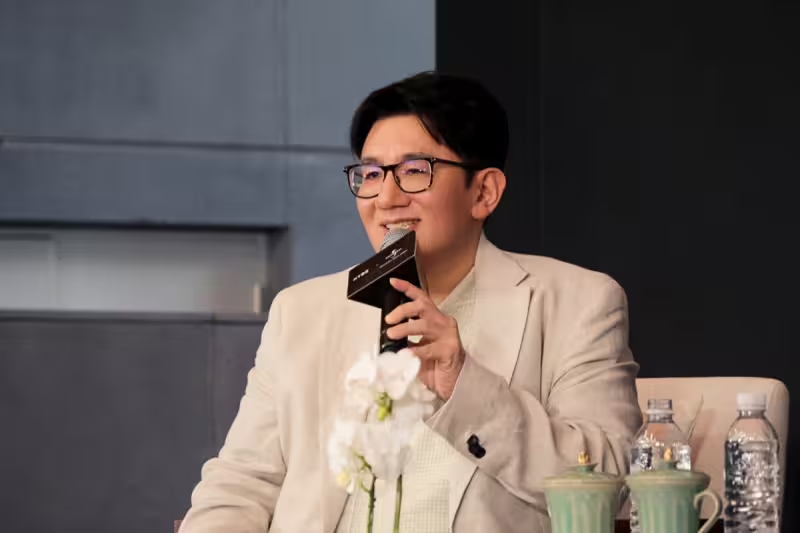
"The way we address this is by being lonely and facing difficulties, yet satisfying fans’ emotions through music and giving them strength in their lives," Bang Si-hyuk told roughly 200 employees at HYBE’s Yongsan headquarters, opening a 90-minute dialogue with Sir Lucian Grainge on June 16 that was livestreamed to staff in Japan, the United States, Latin America, India and other regions.
The exchange gave HYBE personnel direct access to two executives whose companies now anchor much of the recorded-music business. Universal Music Group, Grainge’s company, is the world’s largest music company and accounts for more than 30% of the global recorded music market; HYBE was described at the meeting as the world’s fourth-largest music company. Grainge repeatedly circled back to music itself: "No matter what responsibility you take on, without music, there is nothing," he said, later adding that his "management philosophy is to work surrounded by good music and good people."

The pair used the town hall to cast their corporate relationship as the product of years, not a single transaction. Their working relationship stretches to 2017, when HYBE and UMG first cooperated on distribution for BTS releases in Japan. In 2021 the companies broadened that cooperation into a strategic partnership that brought UMG artists onto HYBE’s superfan platform Weverse and launched the HYBE x Geffen joint venture. Most recently, a 2024 agreement gave UMG exclusive distribution rights across HYBE’s artists and labels and included a minority stake in Weverse, under a 10-year contract.
Bang framed those arrangements as part of a wider responsibility. "I believe companies must address societal discomforts in line with the essence of their business," he said, and he told employees he and Grainge often "discuss how to advance the music industry," a process he described as grounded in "a sense of shared purpose." Bang’s language — about loneliness, difficulty and the obligation to strengthen fans through music — set the moral tone for the meeting more than a corporate road map.

Grainge returned praise in equal measure: "Bang has built a truly unique company and creative culture," he said, and called HYBE’s accomplishments "extraordinary." Yet he also introduced a qualifier that shifted the frame of the day’s disclosures: "We have had many discussions about what UMG and HYBE can do for each other, and these conversations are based on strategy, not transactions."
That line complicated a tidy deal narrative. The companies' public milestones are concrete — a Japan distribution deal in 2017, platform integrations and a joint venture in 2021, and a decade-long exclusive distribution pact plus equity in 2024 — but Grainge’s insistence reframes those moves as steps in a longer strategic play. For employees in the room and staff watching across time zones, the remark turned what might read as a sequence of commercial agreements into an argument about shared aims and ongoing coordination.
What neither executive put on the table at the town hall were the operational specifics that would show how the strategy will be executed next. They reaffirmed mutual values, applauded past achievements, and described a history of collaborative discussions; they did not sketch a public timeline or announce concrete new projects tied to the partnership. For a workforce and a global fanbase accustomed to announcements and rollouts, that left an open question: how will the stated strategy translate into identifiable action?
The meeting’s clearest outcome was less a new plan than a restatement of purpose. Bang and Grainge used the 90 minutes to align tone and intent — to connect creative mission and corporate reach — while leaving the mechanics of the next phase unsaid. Employees and outside observers now have a benchmark: the partnership’s past transactions and the leaders’ shared language. The next public sign that strategy is becoming execution will be the detail that turns those words into projects fans and staff can measure.



