



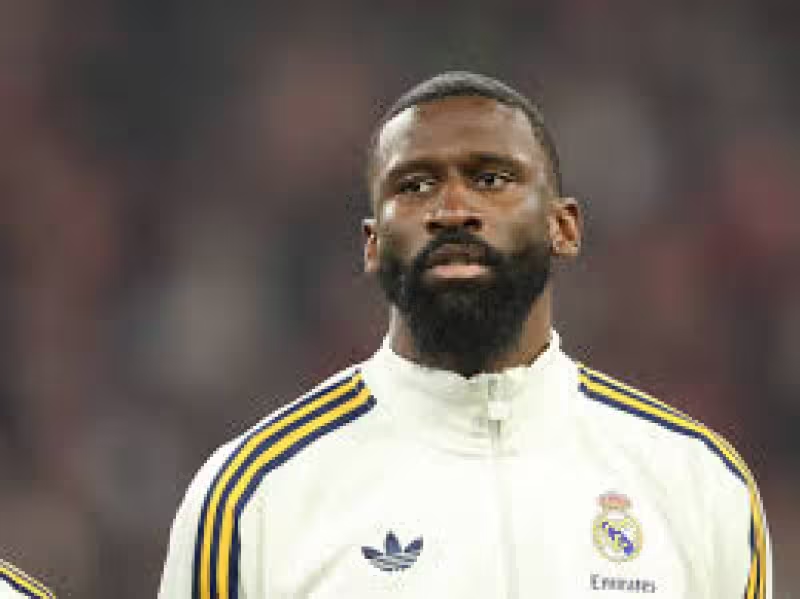
"You have the utmost respect for them. It’s not easy to leave somewhere behind and start somewhere new. Especially as it’s not that people are seeking refuge because they want to – no, because they have to. They have no other choice," Antonio Rüdiger said as he announced his role with the UNHCR's Gamechanging Team, asking the public to listen to people who fled war and displacement.
The 33-year-old Real Madrid and Germany defender framed that plea through the history of his own family: his parents, Matthias and Lily, left Sierra Leone after the country's civil war began in 1991 and settled in Neukölln, Berlin. Rüdiger is the youngest of six; only he and one sister were born in Germany, while the rest of the siblings were born in Sierra Leone or elsewhere after the family left.

Rüdiger tied those private origins to a public argument about how societies treat displaced people, saying refugees "have no other choice" and stressing that "it’s important that they be listened to." He joins a group of footballers in the UNHCR's Gamechanging Team who use their profiles to stand with refugees and challenge simple stereotypes about people on the move.
He recalled the neighborhood life that shaped him in Neukölln: "If someone didn’t have enough food or milk, they visited a neighbour and asked," and "We would share everything. It was this type of feeling. It was one of the best experiences in my lifetime." Those memories of communal care and improvised football pitches underline why he sees sport as a bridge between newcomers and host communities.
"If you look even today: football unites. This is what united us back in those days. We don’t need to speak the same language to understand football. We need a ball, we need some players – like this we connected, more and more," Rüdiger said, describing how playing on a field visible from his bedroom window kept him out of trouble as a child and helped knit a mixed community together.
The facts he cited give weight to his appeal. The conflict in Sierra Leone that began in 1991 lasted 11 years and displaced roughly 2.5 million people. Rüdiger’s family story is one example among many of the long arc of displacement that followed the uprising and subsequent violence in that country.
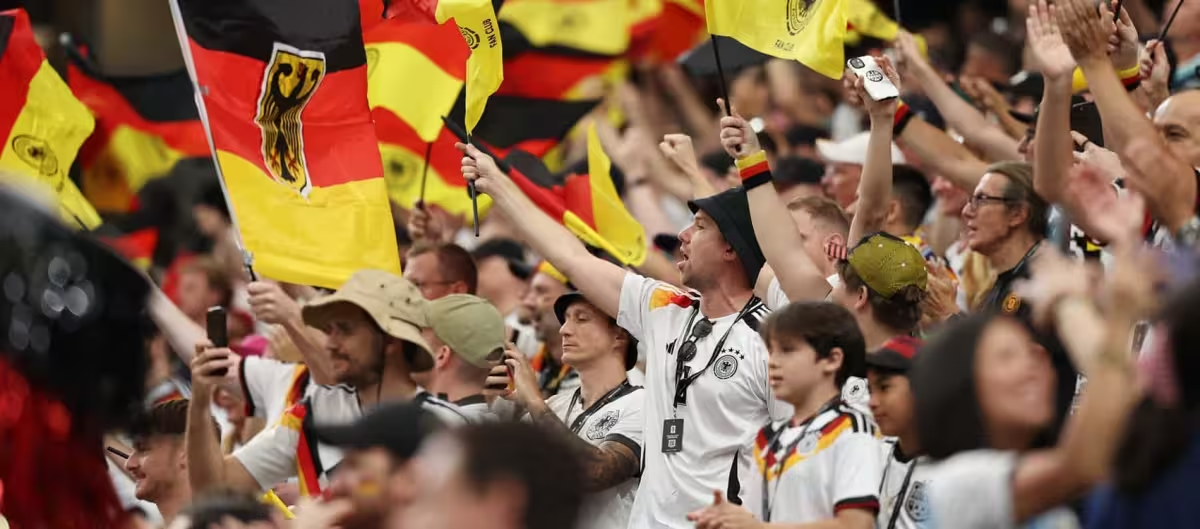
Rüdiger did not limit his remarks to praise. He introduced a note of complexity—"In everything we have good and bad"—a line that resists simple sentimentalism and acknowledges that conversations about refugees often contain contradictions and difficult trade-offs for host communities and newcomers alike.
That friction matters because it is precisely what public debate tends to skip when it turns refugees into statistics or slogans. Rüdiger’s stance is not a call for uncritical acceptance; it is a demand for attention to the lived realities behind headlines, delivered by a high-profile athlete whose family experienced displacement firsthand.
Occupying the dual role of elite footballer and the youngest child of parents who fled war gives his words extra heft. As a Real Madrid player and a member of Germany’s national setup, Rüdiger is a visible figure across Europe. He says his parents moved "for them simple to come here for us young ones to have a better life," a motive he said taught him reverence for the risks older generations take when they leave home.
Joining the UNHCR's Gamechanging Team formalizes that public position, but the announcement left one practical question open: beyond the speeches and the profile-raising, what specific actions does Rüdiger plan to take with the Gamechanging Team to change public understanding or affect policy? The program invites athletes to challenge stereotypes; Rüdiger has supplied the moral case. The operational follow-through — campaigns, visits to refugee communities, advocacy with governments — was not spelled out when he spoke.
For now, his message is clear and personal: refugees are not seekers by choice and should be heard. "Because this happened to my family I can understand those people and feel with them. It’s important that they be listened to," he said.
If Rüdiger’s next steps match the force of his words, his platform could shift some conversations in Europe about who refugees are and why their testimony matters. If not, his comments will remain a powerful reminder that recognition without action is only the start of a harder argument about what comes next.



