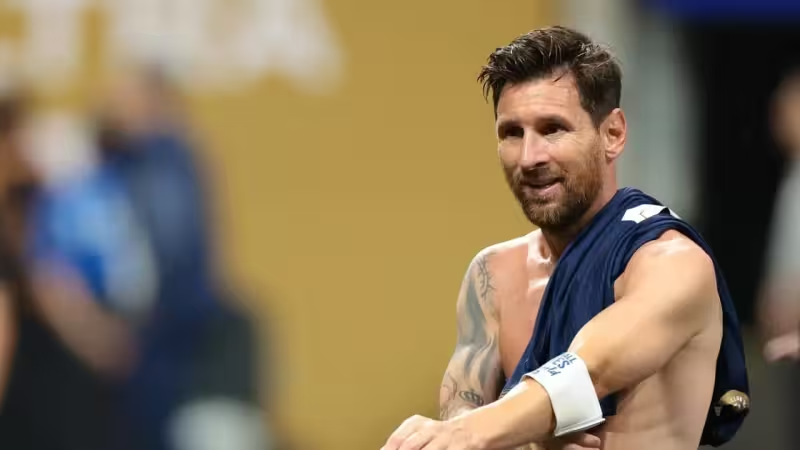
Cristiano Ronaldo will celebrate his 41st birthday in the summer of 2026, the same month the World Cup takes place across the United States, Canada and Mexico; Leo Messi will arrive at the tournament at age 39. Those are the simple facts that frame a larger question fans and coaches will watch when the competition opens: how do two of football’s greatest players keep competing at the highest level as their bodies enter a stage of inevitable decline?
Ronaldo and Messi are widely expected to step onto the pitch once again at the highest level of world sports, but neither is at the physical peak they enjoyed a decade ago. That reality matters now because the 2026 tournament will be the clearest, most public test of how far elite athletes can stretch longevity, and because their presence changes expectations for selectors, opponents and broadcasters in a way that no single statistic can capture.

The underlying biology is straightforward. From about age 30 the body’s ability to use oxygen begins to fall and maximum heart rate decreases. Starting in the fourth decade of life the body also begins to lose muscle strength and muscle quality, with fast-twitch muscle fibers — the ones that power sprints and explosive changes of direction — the first to show the effects of aging. Those shifts mean that the raw physical resources that drove both players’ early dominance naturally shrink as they move toward 40.

What keeps them competitive is a layered approach: discipline, physiological adjustments, high-level sports medicine and careful load management. Strength work remains central — Ronaldo’s regimen is considered very rigorous — and experts recommend combining strength and resistance training at least twice a week even at an older age. Maintaining aerobic fitness year-round is also critical; interval training is one of the central tools both players use to protect speed and cardiovascular fitness without accumulating chronic fatigue.
Recovery and nutrition are the other half of the equation. Muscles, tendons and cartilage take longer to recover at 40 than at 20, so older athletes require stronger training stimuli and more high-quality protein to rebuild and hold on to muscle. That forces a trade-off: to provoke adaptation you need intensity, but to preserve availability you must limit volume and marshal recovery treatments, sleep and precise rest times. Messi and Ronaldo follow strict plans for loads, sleep and nutrition designed to thread that needle.
The practical consequence is clear: both players can still deliver elite performances, but their game has evolved away from sustained physical superiority toward efficiency, positioning and selective bursts. They are not the same athletes they were a decade ago; they have compensated by changing how they train and by leaning on advanced sports medicine and stricter load management to delay decline. That combination explains how a 39-year-old and a 41-year-old can still be relevant at the World Cup without pretending the biological clock has stopped.
The most consequential unanswered question is also the simplest: how effective are these specific training and recovery methods at prolonging true elite-level performance beyond the 2026 World Cup? The tournament will offer the first apples-to-apples measure against the world’s best in full competitive conditions, but it will not answer how long such approaches can hold up. FilmoGaz will be watching which elements — interval volume, strength frequency, protein and recovery prescriptions, and overall load control — correlate with sustained impact as the players pass through their fourth decade.