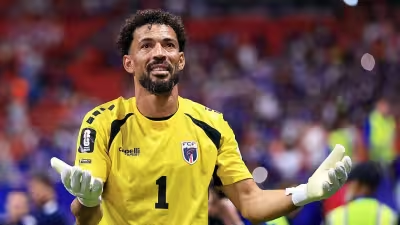
The Asociación Uruguaya de Fútbol asked FIFA to recognise Fernando Muslera as a World Cup legend after the goalkeeper became the first Uruguayan to appear in five editions of the tournament.
The request was filed before Uruguay's debut at the 2026 World Cup and rests on a simple criterion: five World Cup participations. Muslera was part of Uruguay's squads at South Africa 2010, Brazil 2014, Russia 2018, Qatar 2022 and the 2026 tournament in the United States, Mexico and Canada.

The AUF president, Ignacio Alonso, framed the move in historical terms. "Es lógico que Fernando es leyenda. Cuando vos llegás al quinto Mundial… Cuando yo era chico, el único que había podido jugar cinco había sido Antonio Carbajal. Y ahora Messi, Cristiano Ronaldo y Ochoa llegan al sexto," Alonso said, arguing that Muslera "deserves the consideration" that comes with the milestone.
The number here is the point: five World Cups. FIFA recognises players who reach that threshold by allowing them to wear a special patch on their shirt that identifies them as legends of the World Cup, a distinction limited to a small group of players worldwide.
Muslera’s five participations place him alongside goalkeepers and outfield players who have reached five tournaments; lists of such players include Antonio Carbajal, Andrés Guardado, Rafael Márquez, Lothar Matthäus, Manuel Neuer, Gianluigi Buffon, Luka Modrić, Yuto Nagatomo and Fernando Muslera. By contrast, Lionel Messi, Cristiano Ronaldo and Guillermo Ochoa are among those who have appeared in six World Cups.



There is a practical wrinkle the AUF acknowledged: FIFA does not automatically declare every qualifying player a legend. Alonso made clear the federation's view but also described the process—national associations request the recognition, and FIFA grants the special status and the associated patch.
That procedural detail is the story's tension. The AUF can call Muslera a legend and submit the paperwork; only FIFA can approve the formal recognition and the patch that accompanies it. The federation's description of Muslera as a legend therefore relies on a decision that must come from another organisation.
For Uruguay, the stakes are symbolic more than competitive. Muslera is the first and only Uruguayan to reach five World Cups, and several long-serving teammates—Pedro Virgilio Rocha, Diego Godín, Martín Cáceres, Edinson Cavani and Luis Suárez—have four appearances each. Muslera’s milestone is a national marker of longevity and presence at the game’s biggest stage.
The AUF also noted a detail about Muslera’s early World Cup involvement: he was in the 2010 squad in South Africa but did not play any minutes. That fact does not affect the count of tournament participations that underpins the federation’s petition.
If FIFA approves the AUF request, Muslera would receive the formal legend designation and the special shirt patch that accompanies it—an emblem that, in modern football, confers a compact, visible history on a player’s career. If FIFA declines or delays, Muslera’s recognition will remain a national accolade rather than an official World Cup honour.
The unanswered question is now clear and immediate: will FIFA ratify the AUF's petition and award Muslera the legend status it reserves for five‑time World Cup participants? The federation has submitted its case; FIFA's response, and any timetable for it, has not been reported.