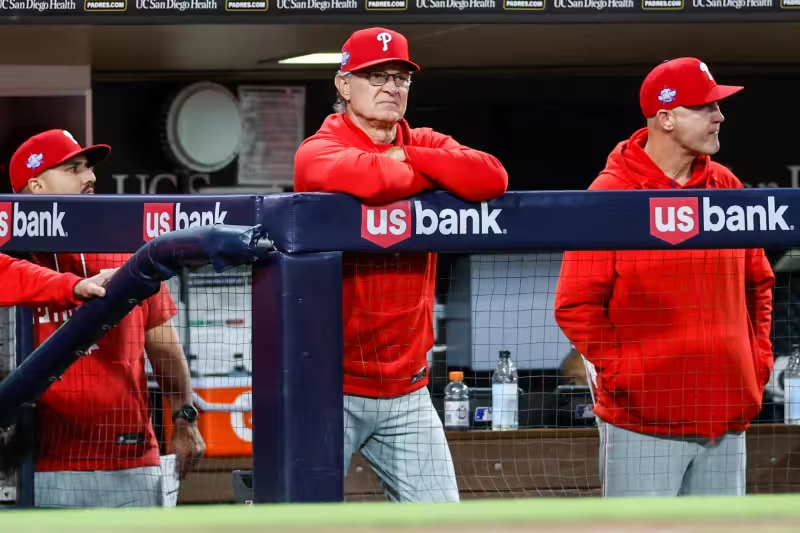
“If you’re the team that doesn’t get the last out, it’s a crash,” Don Mattingly said with the bluntness that has marked his career since he finally reached a World Series late in life. The line landed differently in Philadelphia because Mattingly arrived not as a consultant but as the club’s manager, and since he took over the Phillies the team has looked noticeably sharper on the field.
The change is visible in the way the roster moves through games: players have shown more urgency than they did at the start of the year, and lineups are finding better matchups. Those are the everyday measures managers are judged on, and they are the reasons Mattingly’s presence has become an immediate story in a city that expects results.

John Schneider, who worked with Mattingly in Toronto, put it simply: “It was experience, it was the quiet swagger that he had,” Schneider said. “He was very calm and confident. It was great for me to be able to bounce things off of him.” Schneider added that Mattingly’s steady reminders — “just do what you’ve been doing and you’ll be all right” — helped steady a club that needed direction.

Those compliments matter because Mattingly’s résumé is the kind everyone in a clubhouse notices. He spent four decades in the big leagues before last year’s trip to the World Series with the Blue Jays, a run that ended in a Game 7 loss to the Los Angeles Dodgers when he was 64. He joined the Jays staff in 2023 and, before taking the Phillies job, had spent three seasons as a bench coach and offensive coordinator. His résumé also includes division titles with the Dodgers from 2013–15 and six seasons as manager of the Miami Marlins, where his teams never advanced beyond the NLDS.
Context sharpens the question that follows each early-season managerial change: did the manager fix anything, or are the players correcting course on their own? Mattingly’s history — long chasing his first World Series experience until last year, and then coming within one game of a title — is now part of the narrative Philadelphia uses to judge him. The club’s improved feel on the field fits with a manager who has spent decades around postseason baseball and who can talk plainly about the emotional swing of elimination: “It’s hard to get there, it’s hard to move through each round,” he said.
Still, the friction is obvious. The same runs and matchups that look like managerial savvy can also be read as the roster finally playing to its talent. Players respond to short-term stimuli: a new voice, a different routine, a reminder of fundamentals. Those are effects that will flatten out as the sample size grows. In short: the team looks better under Mattingly, but some of that credit may properly belong to the players themselves.
That uncertainty is the story now. Mattingly’s arrival changed the tenor of games and the clubhouse; his past — the long climb that ended in a World Series trip, the Dodgers division crowns, the Marlins’ postseason ceiling — gives weight to his methods. What remains unresolved is the single consequential question fans and front-office people will be watching: how much of the Phillies’ uplift is the manager, and how much is the roster finally living up to its own promise? Until the days pile up into weeks and the sample grows, the answer is the lever that will determine Mattingly’s lasting claim on this team’s turnaround.