



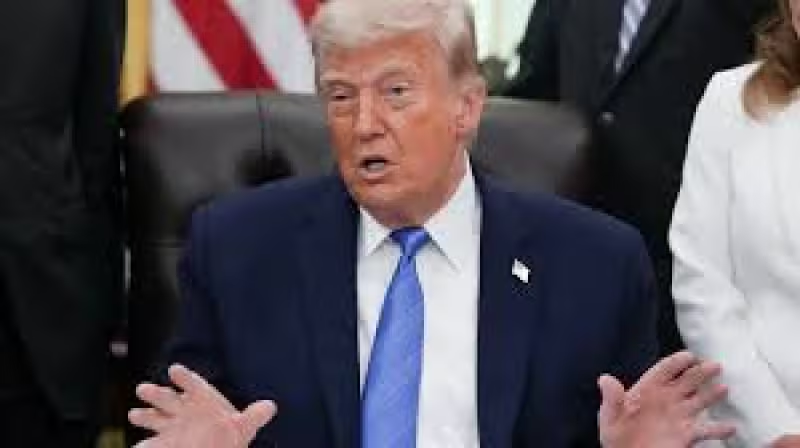
The US military launched additional strikes on Iran on Wednesday, US Central Command said, describing them as "additional self-defense strikes" and saying "The strikes are in response to Iran's unwarranted and continued aggression."
The action followed a sharp public warning from former President Donald Trump, who wrote on Truth Social, "We hit them hard yesterday and we're going to hit them hard again today," and accused Iranian leaders of having "taken too long to negotiate a deal." US Defence Secretary Pete Hegseth added that bombs would be "dropping on key facilities in Iran," underscoring Washington's readiness to press its campaign of pressure.

The strikes came after a cycle of attacks that accelerated on Tuesday, when a US helicopter was downed in an incident blamed on Iran and the Islamic Revolutionary Guard Corps responded by targeting US bases across the Middle East. Explosions were reported on the Iranian island of Qeshm and in the port cities of Bandar Abbas and Sirik as the exchange spilled over into multiple locations.
The exchange is the latest in US and Iran news and marks a clear escalation in a week of tit-for-tat airstrikes. In April the two sides agreed a ceasefire that was meant to last for two weeks; that pause never produced a durable calm. Both militaries have since targeted military and surveillance sites intermittently without returning to full-scale hostilities, and recent efforts to broker negotiations between Washington and Tehran have stalled.
The US framed Wednesday's strikes as a defensive response to what it called repeated Iranian aggression. US Central Command's statement used the phrase "additional self-defense strikes" and tied the action to Iran's "unwarranted and continued aggression." That legal framing gives Washington a public justification for using force while signalling to allies and adversaries that strikes will continue unless Iranian behavior changes.
Iran pushed back immediately. The foreign ministry accused the United States of "damaging the diplomatic process through the contradictory message it sends," arguing that public threats and on-the-ground attacks undermine any chance of talks. President Masoud Pezeshkian warned Tehran "will stand firm against any pressure or threat," a phrase that signals resistance without specifying reprisals.
The friction between the competing narratives is stark: Washington says the operation is defensive and limited to military and surveillance targets; Tehran says the strikes sabotage diplomacy and escalate pressure. Neither side has provided a full inventory of the specific sites hit on Wednesday, and that gap leaves analysts unable to judge the scale of the damage or the immediate operational impact inside Iran.
Practically, the strikes widen the geographic footprint of the conflict and increase the chance of further, unplanned clashes. Both sides have already struck at military and surveillance installations this week, and the downing of the helicopter on Tuesday proved those attacks can produce significant kinetic consequences. Hegseth's comment about "dropping on key facilities" and Trump's public threats create a clear trajectory: more pressure if negotiations do not move.
What remains unclear is whether this pattern will force Tehran back to the negotiating table or push both capitals into a deeper spiral. The central unanswered question is operational: which precise targets were struck on Wednesday, and will those strikes alter Iran's calculations enough to restart stalled diplomacy or provoke new reprisals? How Washington answers that question — whether by naming targets or by moderating public rhetoric — will determine whether Wednesday is remembered as another episode in a contained tactical exchange or as the opening of a broader confrontation.



