




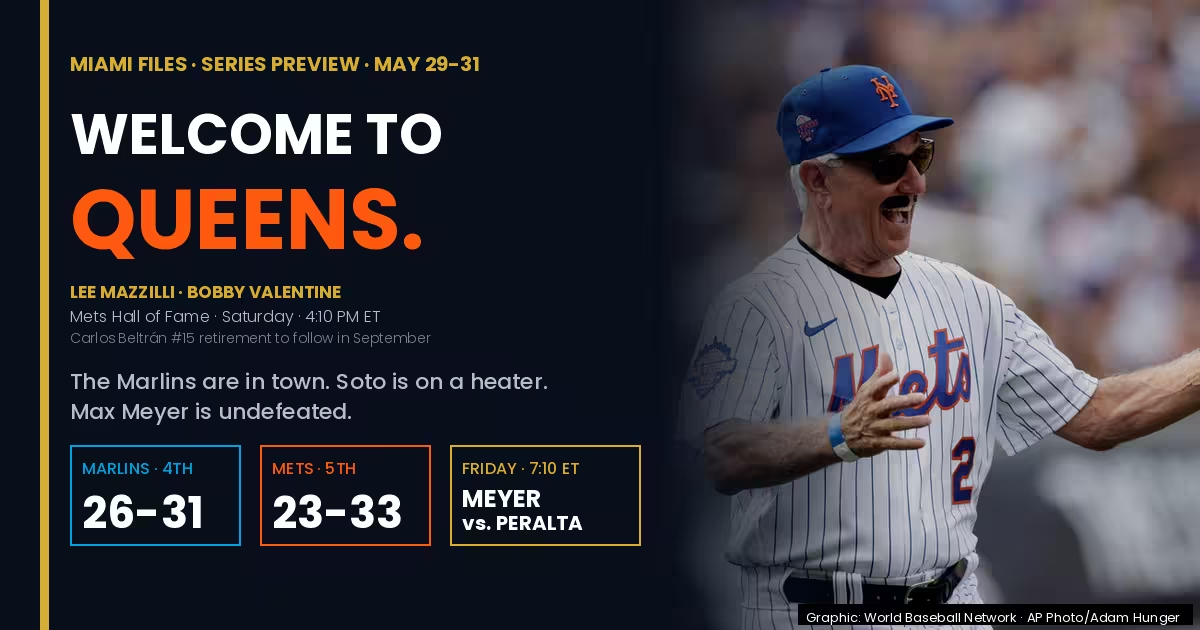
Freddy Peralta has surfaced as a realistic trade target for the Tampa Bay Rays — not a long-term fix, but a high-end starter who could eat innings down the stretch and be trusted to take the ball in a playoff series.
The interest has been driven by a simple arithmetic and timing problem: Peralta has shown the durability and swing‑and‑miss profile the Rays prize, while the New York Mets sit outside the playoff picture and would face the choice of selling an asset before he reaches free agency this winter.

Peralta’s résumé checks the most urgent boxes. He has topped 160 innings in each of the last three seasons, consistently suppresses hard contact and generates swings and misses, and throws his fastball more than 50% of the time against both right‑ and left‑handed hitters. Those two features — volume and miss‑rate — are the core traits a team asks for when it wants a starter who can be handed a postseason game.
He also mixes multiple secondary pitches that produce chase and misses, which is why evaluators describe him as someone who can be trusted to take the ball in October rather than only serve as a mop‑up option. That makes him an attractive, plug‑and‑play profile for a club that expects to push into the postseason and needs a reliable top‑end arm for series planning.
Why Tampa Bay? The Rays’ rotation is performing well enough this season, but the club is juggling several pitchers with relatively strict workload limits and a set of roster constraints that raise the value of a durable, high‑strikeout starter. Shane McClanahan and Griffin Jax are among the pitchers on managed plans; Drew Rasmussen’s workload is being carefully handled given his injury history; and the team will be without Ryan Pepiot this season. Those factors create a hole not in quality but in reliable, available innings — exactly the niche Peralta would fill.
All of that comes with a cost. Peralta was presented as a short‑term rental of a high‑end starter: the acquiring team would get a few months of control rather than a multi‑year window. Because of that limited control his trade value has retreated from what it was in the offseason. Still, teams would likely have to pay more to acquire Peralta than they did for a lower‑cost deadline move such as Luis Arraez; the description attached to his market suggests a package requiring significant top prospects rather than spare depth pieces.
That price versus payoff is the core tension. Starting pitching is the most expensive commodity at the deadline, and the Rays would be weighing two clear but uncomfortable facts: Peralta would materially strengthen their short‑term and postseason plans, but doing so would require surrendering premium prospect capital for only a few months of an established frontline starter. For a small‑market club that prizes controllable assets, that trade‑off is not academic.
There is also a structural unknown: the Mets’ posture. If New York remains outside the playoff picture as the deadline approaches, the club might decide to capitalize on Peralta’s market before he hits free agency this winter. If the Mets hold their course, or if their asking price proves immovable, the Rays would either have to escalate an offer into prospect‑market territory or stand pat and rely on internal depth and careful innings management.
The central unanswered question is straightforward and consequential: will the Mets make Peralta available in a way the Rays can afford to pursue? If they do, Tampa Bay will face a classic deadline decision — surrender top prospects for a short but potent burst of starting pitching, or protect the farm and enter October with a rotation whose talent is proven but whose innings are tightly rationed.



