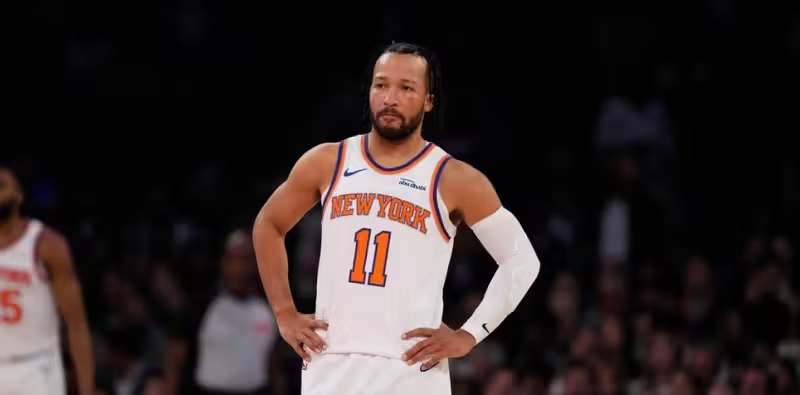
Game 3 of the NBA Finals opens with Jalen Brunson penciled to receive a heavier dose of the ball after San Antonio’s Game 2 blueprint — doubling him early and often — held him to 20 points. Brunson has already taken 56 shots across the first two games (31 in Game 1, 25 in Game 2), and that volume makes him central to both the Knicks’ offense and the betting market for the night.
The raw numbers underline the spotlight: Brunson is averaging 25.0 points in the series but has made just 33.9% of his shots. Oddsmakers are pricing a reaction — a 30-plus points prop for Game 3 sits at +172 — reflecting the idea that New York will either get Brunson more opportunities or he will push through San Antonio’s early doubles. Bettors and viewers should note that his usage has remained extremely high even as his efficiency has dipped.

San Antonio’s Game 2 approach was straightforward and visible: force help on Brunson early, concede open looks elsewhere, and then hope to limit damage late. The Knicks, by design or execution, cashed those open looks and built a sizable lead; the Spurs only reverted to one-on-one coverage against Brunson down the stretch, and still managed a late charge before falling short. That mix — early doubles, late single coverage — is the template that both teams will test again in Game 3.
The Spurs’ frontcourt rotations complicate the matchup for New York. Karl-Anthony Towns represents a difficult opponent for Luke Kornet, and Kornet’s two-game usage has been sparse and costly: 18 total minutes, one combined point and a cumulative plus/minus of -14. San Antonio also has Kelly Olynyk, Mason Plumlee and Bismack Biyombo available off the bench, a group that gives head coaches multiple ways to respond if New York chooses to hunt mismatches or clear space for Brunson.
The key tension heading into tipoff is simple and consequential: Brunson’s volume has been a constant, his finishing has not. He took 31 shots in Game 1 and 25 in Game 2; those totals produce a predictable line of attack for the Spurs but also create betting angles. Brunson has called his own performance subpar, a candid admission that frames Game 3 as both a redemption spot and a trap. If San Antonio doubles again early, the Knicks’ open shooters must convert; if they don’t, Brunson will get more one-on-one looks and the 30-point prop at +172 becomes realistic.
Practically, what to watch in the first quarter: how often the Spurs send a second defender at Brunson on initial ball screens and whether New York answers with quicker ball movement or runs designed for Brunson to attack the paint. Late-game patterns matter too — San Antonio’s switch back to one-on-one down the stretch in Game 2 allowed Brunson to hunt his shot in isolation; the Spurs’ willingness to abandon early help could decide whether New York protects a lead or cedes momentum again.
The most consequential question for Game 3 is also the simplest: will San Antonio stick with the early doubles that blunted Brunson in Game 2, or will it adjust its coverages and personnel in a way that forces the Knicks to diversify their offense? Brunson’s high shot volume guarantees he will be the focal point; whether those shots fall, and whether San Antonio changes course midgame, will determine both the scoreboard and the betting outcomes tonight.