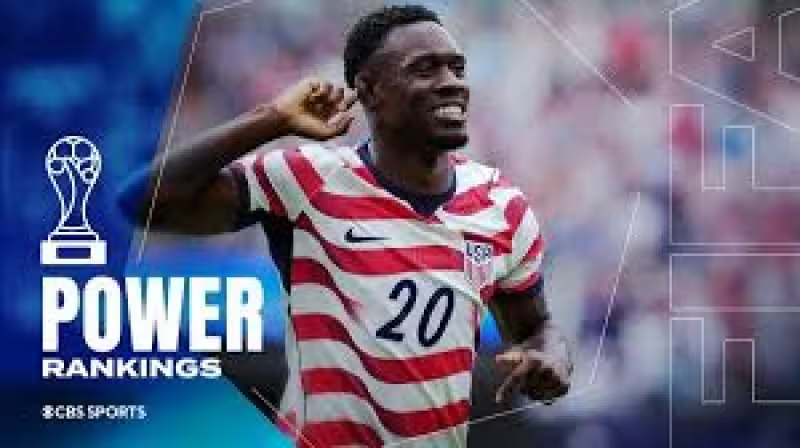
A pre-tournament ranking of the 48 teams bound for the 2026 World Cup places Spain and France at the head of the field, with other heavyweights — Argentina, Brazil, England and Germany — close behind as the tournament opens on June 11 in Canada, Mexico and the United States of America.
The Athletic’s list, adjusted in April once all qualifiers were confirmed, rates Spain and France as having the strongest starting XIs on paper. Spain’s only flagged concern was the fitness of Lamine Yamal, but the ranking noted he was likely to feature during the group stage. France’s depth is the opposite problem: the attackers named as top options include Kylian Mbappe, Desire Doue, Ousmane Dembele, Michael Olise and Rayan Cherki, and the ranking explicitly said at least one of those players will not be in France’s first-choice team.

The ranking frames Argentina as the defending champions from Qatar in 2022, managed by Lionel Scaloni and still led on the pitch by Lionel Messi, who will turn 39 during the tournament. Argentina’s recent form is also underlined by back-to-back Copa America titles in 2021 and 2024.
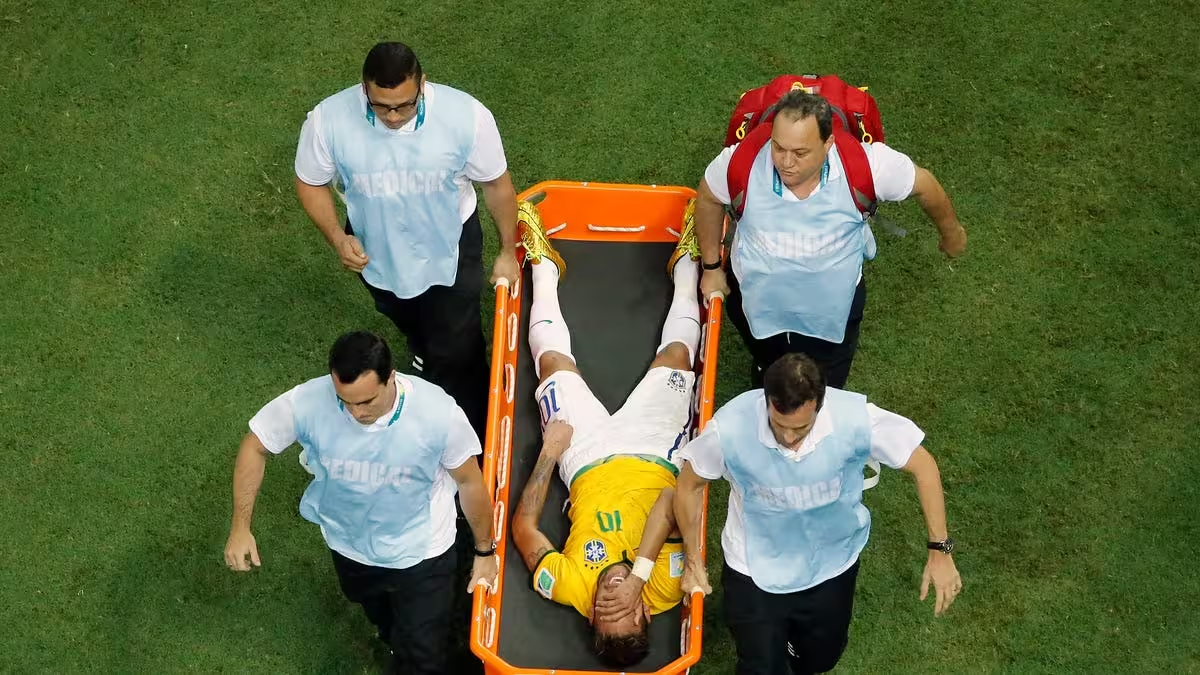
Brazil’s list was headlined by Neymar, and the assessment added that the rest of Carlo Ancelotti’s selection looked extremely strong. England faced criticism for notable absences: Phil Foden and Cole Palmer were left out of the squad, while Thomas Tuchel retains access to Harry Kane and Ollie Watkins — Kane arriving after a run that included successive hat-tricks and Watkins finishing with six goals in five games. Germany’s announcement brought the return of Manuel Neuer, a presence the ranking counted as significant for their chances.

Put plainly, this is a pre-tournament stock-take rather than a projection of match results. The April update came after the final qualification spots were settled and is explicitly a snapshot of squad strength, balance and depth across 48 teams, not a forecast of where each nation will finish when the final whistle blows in 2026.
The central tension in the ranking is selection friction. Spain’s evaluation hinges on recovery and availability: a fully fit Yamal tightens an already strong spine. France’s evaluation hinges on abundance — a list of top attackers so deep that manager choices will force world-class players onto the bench. Those are two different managerial problems with a similar end: finding the optimal XI under tournament pressure.
For managers and fans the practical consequence is immediate. Pre-tournament optics now fall into two categories — teams that must manage injuries and minutes, and teams that must manage egos and cuts. For Spain, monitoring one player’s fitness could change an otherwise settled plan. For France, trimming the attacking list will be a headline-making decision before the first whistle.
The ranking sets expectations and provides a shorthand for who looks strongest on paper, but it leaves important questions unanswered. The full ordered list of all 48 teams — and how fine the margins are between those spots — was not supplied here, so readers know who the top contenders are but not how crowded the field becomes beneath them. The real test arrives on June 11, when selection calls — whether keeping Yamal on the plane or deciding which French attacker starts — will begin to turn a pre-tournament World Cup standing into results on the field.