



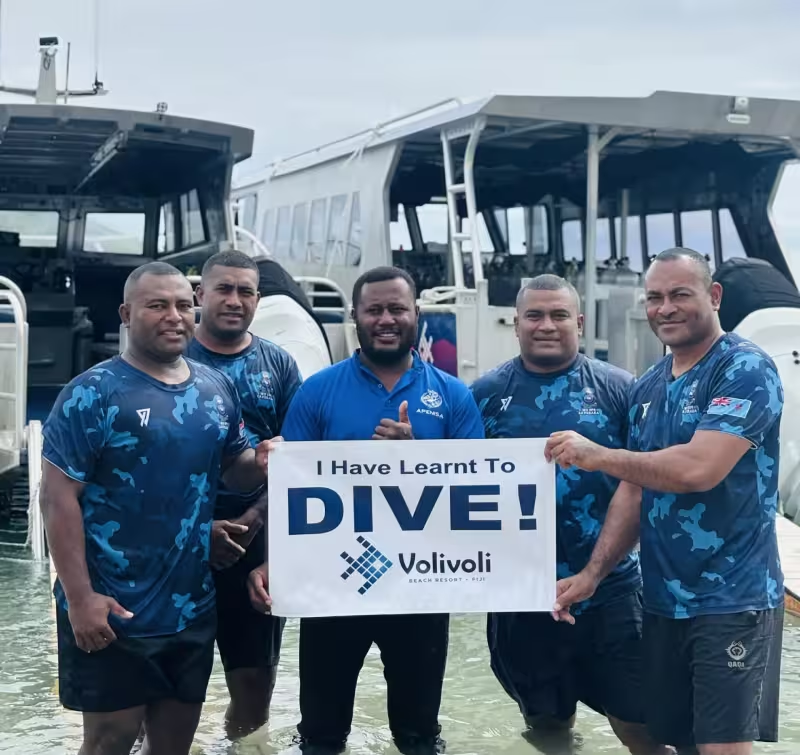
Sgt. Netava completed his open‑water course and emerged from training a certified autonomous diver, one of four Fiji Police Force officers who took part in an intensive program held at Volivoli Beach Resort during a Divers Alert Network Continued Medical Education conference.
The Ra Divers team at Volivoli partnered with the Fiji Police Force to train Sgt. Netava alongside Constables Viliame, Pita and Alipate; the officers "successfully completed all course components with confidence and competence," and are now certified autonomous divers prepared to use those skills within their units.

Volivoli used the same conference to introduce six local Fijian hyperbaric doctors to the underwater world — Drs. Akuila, Shivankar, Asena, Shane, Sitiveni and Maurice — bringing medical professionals who work with diving-related illnesses into direct contact with the environment their patients experience.
Simon, a lead organiser at the event, framed the effort as communal as much as technical. "Building strong and safe communities throughout Fiji is everyone’s responsibility," he said. "We believe community knowledge sharing is not only vital to growth, development, and understanding, but it is also a key component of our culture." He added: "Networking and knowledge sharing make all of us stronger, wiser and safer!"
The numbers are small but precise: six local hyperbaric doctors met the sea for the first time under the conference umbrella, and four police officers gained formal open‑water certification. That pairing — medical specialists and frontline officers — is the clearest, dateable result from the recent Divers Alert Network CME hosted at Volivoli.

Context arrived after the dives. Adrian Stacey, whose own career spans more than 24 years since he first learned to dive on the Great Barrier Reef, has worked as a dive instructor and underwater photographer across Egypt, Costa Rica, Indonesia, Thailand, Mexico and Saba before settling in Australia. That kind of international experience informed the instruction available at Volivoli and helped frame the conference as a bridge between global diving medicine and local practice in Fiji.
But the training also exposes a gap the event did not close. Organisers emphasised knowledge sharing and community safety, yet they did not specify which local operational need this particular set of instructors and trainees was intended to meet. The record identifies who trained and who learned, but not why these six hyperbaric doctors and those four police officers were chosen for underwater introduction now, or which precise safety shortfall in Fiji the training will address.
That omission matters because the link between classroom or pool and an operational benefit depends on matching skills to a mission: medical teams might be prepared to treat decompression illness only if there is a predictable patient flow, and police divers are most valuable when their duties require underwater search, rescue or evidence recovery. The conference created the capability; it did not, in the available facts, attach it to a map of need or a plan for deployment.
The immediate consequence is clear. Sgt. Netava and his colleagues have new qualifications that broaden the islands’ pool of trained divers and place local hyperbaric doctors one step closer to hands‑on understanding of the underwater hazards they treat. What is not clear is the next administrative step: how those qualifications will be integrated into Fiji Police Force operations, nor whether the newly trained doctors will follow with clinical protocols tied to increased diving activity.
The most consequential unanswered question is therefore operational: will these certifications translate into a coordinated plan that uses new diving capacity to improve emergency response and patient outcomes across Fiji? The source confirms the training and the certifications — it does not confirm what comes after.



