



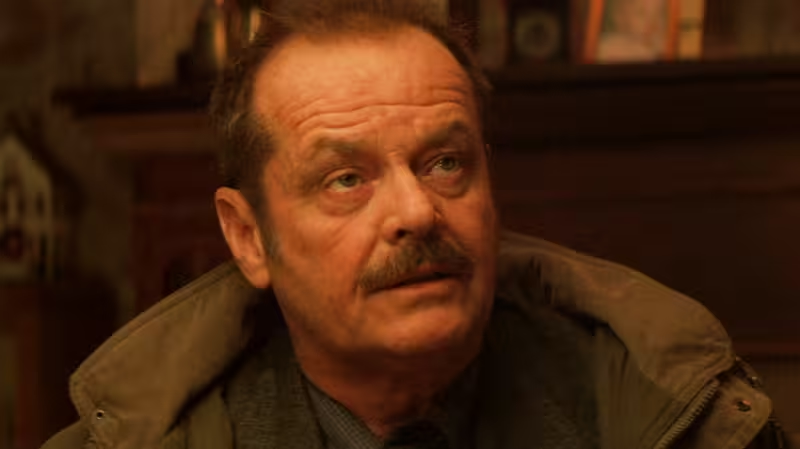
Jack Nicholson gives one of his quietest, most exact performances as Jerry Black in Sean Penn's 2001 crime thriller The Pledge — a turn Roger Ebert called the "finest performance" of the actor's career, even as the film stalled commercially, grossing $29.4 million against a $37 million budget and failing to make much of an impression on audiences.
Nicholson's Jerry Black is a Reno, Nevada detective on the verge of retirement who becomes drawn into a new case on the night of his retirement party. The performance is pared back: less showmanship, more accumulation of small decisions and a nervous, weary gravity that reshapes a familiar cop story into something quieter and darker. Sean Penn directed the film, and critics singled out Nicholson's restraint as the movie's defining feature.

The decisive measure of the film's reception is stark. Roger Ebert awarded The Pledge four stars and singled out Nicholson's work with the phrase that has followed the film: "finest performance." Yet the numbers tell a different story. With a $37 million budget and a $29.4 million return, the picture never found a wide audience, and its commercial shortfall helped consign it to the category of often-overlooked crime thrillers despite later reassessments.


That mismatch — critical exaltation and public indifference — is central to why The Pledge matters today. The film is more than two decades old and still holds up for viewers who return to it: the narrative's moral stubbornness, Penn's careful direction, and Nicholson's subdued commitment resist easy summation. Nicholson himself arrived at the project after a long break following 1997's As Good as It Gets, and the performance marked a tonal shift from the grand, comic-tragic leads that had defined much of his earlier work.
What followed for Nicholson was not a string of similar dramas. After The Pledge and 2002's About Schmidt he consciously pivoted toward comedy, exploring different emotional registers rather than repeating late-career intensity. He made his last credited film in 2010, How Do You Know, and then stepped back from Hollywood. The Pledge, in this arc, reads as both a capstone of a certain dramatic mode and an odd, luminous outlier that critics loved but audiences largely overlooked.
The friction between praise and performance — the movie critics adored and the ticket-buying public ignored — reframes how we evaluate Nicholson's late work. A four-star endorsement from Ebert matters because it locates The Pledge at the high end of the actor's craft; yet box-office numbers and audience indifference kept the film from altering the marketplace for similarly serious, unflashy dramas. That gap helps explain why The Pledge survives as a viewing recommendation rather than as a career changer.
If the question is whether The Pledge remains a vital example of Nicholson's range, the critical record answers yes: his Jerry Black is proof that, well into his career, Nicholson could vanish into a role without theatricality. If the question is why that peak did not reverse his retreat from major-studio mainstream work — and why he left Hollywood after 2010's How Do You Know — the facts stop short. The film endures as a compact, underseen masterclass; the motive for Nicholson's eventual withdrawal remains the story left to be told.



