



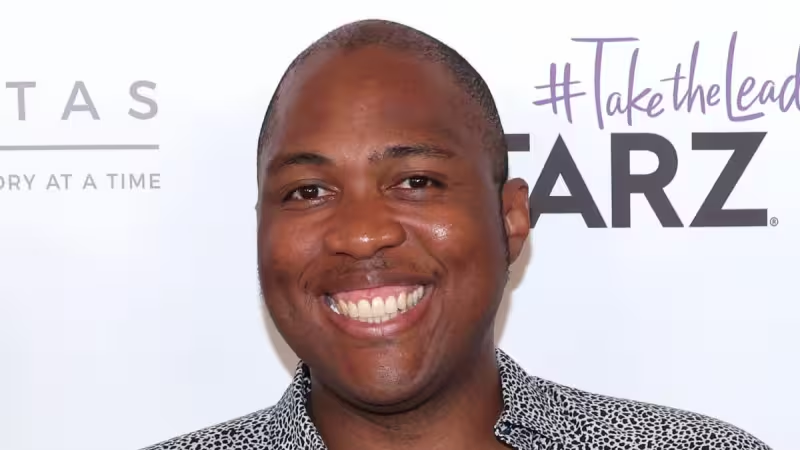
John Lowe filed a lawsuit Wednesday, June 17, in California against CBS Television Studios and three Matlock producers, alleging racial and sexual harassment on the show's writers' staff and that his July 2025 termination was retaliatory.
Lowe says he worked on Matlock from October 2023 until July 2025 and that the complaint names showrunner Jennie Snyder Urman and executive producers Nicki Renna and Jeffrey Lieber. The filing describes specific incidents Lowe says created a hostile workplace for Black cast and crew: he alleges Urman referred to Juneteenth as "Coonteenth," that she brought her dog into the writers' room and said her children “didn’t like the aesthetic” of the pet because of its black color, and that Lowe was coerced into caring for that dog for nearly a year.

The complaint also recounts disturbing conduct attributed to Renna. Lowe alleges Renna told him a Black cast member, Eme Ikwuakor, "can barely read," and that Renna called Lowe late at night saying she "was in bed wearing only her underwear." Lowe says he was hired as an executive story editor in 2023 and that, after he reported the Juneteenth comment in June 2025, he was told on July 2 that he would be terminated; his work on the series ended in July 2025. The suit frames those events as retaliatory, saying his firing came roughly two weeks after he raised the Juneteenth remark internally.
The numerical frame sharpens the complaint: Lowe's tenure spans from October 2023 to July 2025; the Juneteenth incident is alleged in June 2025; Lowe says he was verbally informed of termination on July 2, 2025; the lawsuit was filed June 17. On balance, the filing seeks to hold both the studio and individual show leaders accountable for what Lowe describes as repeated racially and sexually offensive conduct and supervisory abuse.
CBS Studios pushed back in a statement. The company said, "We are committed to maintaining a safe and respectful environment for everyone and take all workplace complaints seriously." The spokesperson added, "In this instance, a thorough investigation was completed, and we were unable to find support for his allegations," and also said the studio "look[s] forward to vigorously defending this lawsuit."
That public denial is the central tension. Lowe's legal filing lays out a string of alleged remarks and actions that, if corroborated through discovery, would test the scope and depth of the studio's internal probe. Lowe’s counsel put the dispute in blunt terms, writing that "There is no excuse for this blatant racism and harassment. CBS should be ashamed for allowing it, and the Matlock showrunner and producers should be held accountable."
Context in the complaint notes the allegation is not isolated: the filing portrays a pattern affecting Black employees and references a broader backdrop of recent personnel disputes at the studio. The complaint arrives roughly three months after another cast member filed an arbitration claim over a prior firing, underscoring that legal fights tied to the series are already active.
The next step is ordinary litigation. With CBS signaling an intent to defend vigorously, the case will move into the discovery phase, where depositions, emails and production documents could either substantiate Lowe’s portrait of the writers' room or uphold the studio’s finding that the claims could not be supported. The immediate practical outcome is procedural: the lawsuit opens a public record that will force both sides to produce evidence and answer under oath what happened on the Matlock set.
At stake is not only Lowe’s claim for redress but the credibility of a studio investigation the company says cleared the show’s leadership. The court will now be the forum that decides which account—Lowe’s allegations of a hostile environment or CBS’s conclusion after investigation—carries the weight of proof.



