



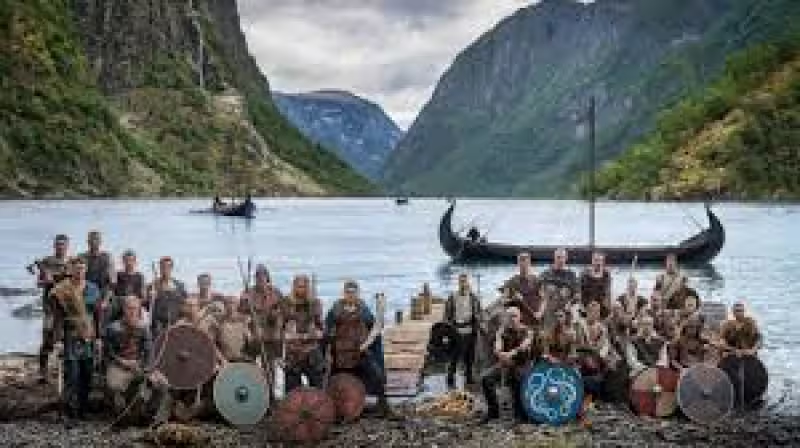
Erling Haaland finished Norway's qualifying campaign as an unmistakable lever: 16 goals in eight matches propelled Norway Fc into the 2026 World Cup, snapping a 28‑year absence from the tournament and turning a small nation into a headline act.
The scale is simple. Haaland has 55 goals in 49 matches for his country, and this qualifying run — a remarkable 16 strikes across eight fixtures — is the direct reason Norway reunited with the World Cup stage for the first time since 1998. For a country of 5.5 million people, qualification is not routine; it is national news.

Haaland's rise reads like a map of modern European development. Born in Leeds in 2000 and taken to Bryne in 2003, he moved through Bryne's youth teams after being spotted in his early teens, joined Molde in 2017 when Ole Gunnar Solskjaer was manager, then moved on to Red Bull Salzburg and Borussia Dortmund before signing for Manchester City in 2022. He remained eligible for England because he was born in Yorkshire, but as England's manager observed in 2020, "With players like him, they're quite clear where they want to play" and "He feels that allegiance to the country that he's playing for now and you're always very respectful of that."
The simplicity of the numbers obscures the strain they carried. Haaland has been cast as the player carrying Norway's hopes — a sharp burden given that he was born two years after Norway last stood at a World Cup in 1998. That gap matters: fans and media framed this qualification as both a personal mission for Haaland and a collective revival for a team that has waited almost three decades to return.

There is a human arc beneath the statistics. A player born in England, developed in a small Norwegian town, who climbed Molde's ranks under Solskjaer and then through Europe's fast lanes to Manchester City, now shoulders expectation not because of nationality alone but because his scoring record demands it. The goals converted hope into a result; the result converted expectation into a ticket to the 2026 tournament.
Still, the story contains a gap. The record of 16 goals in eight qualifying matches explains how Norway reached the World Cup but does not detail the specific moments in the match that sealed qualification or the supporting performances that complemented Haaland's scoring. That absence matters because a single player's goals are only part of a tournament campaign; how Norway's squad, coaches and system will translate those goals into success against the world's best is an open question.
What happens next is straightforward and urgent: Norway will prepare for the 2026 World Cup, and everything about that preparation will be measured against Haaland's output. The sharper question is whether Norway can build the supporting architecture — tactically and in personnel — to turn Haaland's prolific scoring into tournament progress. For a nation that waited 28 years, the bar is now higher than it was before his goals began to arrive.
For Haaland, the narrative is already settled in headlines: a 25‑year‑old striker whose club trajectory and international form combined to end a long drought. The unresolved test is collective — whether a country of 5.5 million, with its talisman born after the last appearance, can convert one player's extraordinary scoring into sustained World Cup success.



