



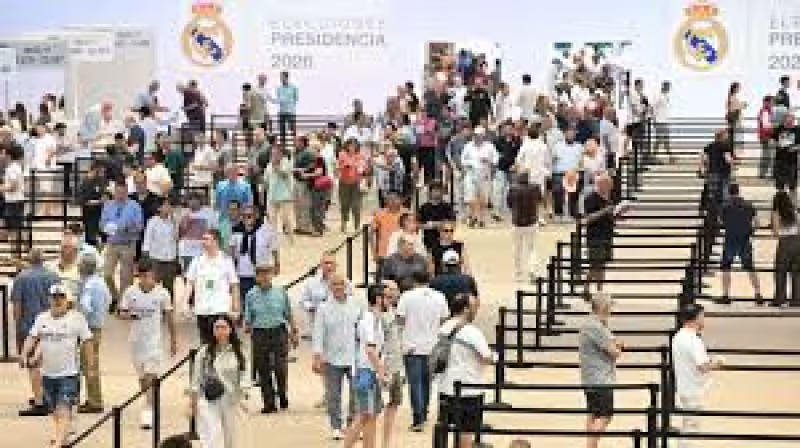
Real Madrid will hold a presidential election on Sunday — the club’s first vote for president since 2006 — after Florentino Perez announced the call at a May 12 press conference and urged rivals to "come out of the shadows."
The election matters because it is how members of one of Spain’s member-owned clubs choose their leader. Voting is limited to club members who are of age, have full legal capacity, have been registered with Real Madrid for at least one uninterrupted year and appear on the club’s electoral roll. Members may cast ballots by post or in person at the basketball pavilion in Valdebebas, where voting runs from 9am to 8pm on Sunday.

Candidates face steep, clearly defined barriers. Only Spanish citizens can run. Prospective presidents must have been club members for 20 years and must advance a bank guarantee proving personal wealth equal to 15 per cent of the club’s annual budget — roughly €187m this season, based on a reported €1.25 billion budget. That threshold reflects changes to the statutes made in September 2012 and is intended to limit the field to those with significant resources.
Those financial rules are not academic: Real Madrid’s budget has ballooned from €518.7m in 2012–13 to about €1.25bn this season, so the 15 per cent requirement has grown in absolute terms. Other Spanish clubs with member-elected presidents use similar safeguards; the rule is a practical filter as much as a test of seriousness.
The mechanics of the vote are straightforward but conditional. A formal candidacy period opens for 10 days after the election is called; the club’s electoral board will then decide which candidacies meet the conditions. Crucially, a vote will only take place if two or more candidates are accepted — otherwise the process can produce no contest.
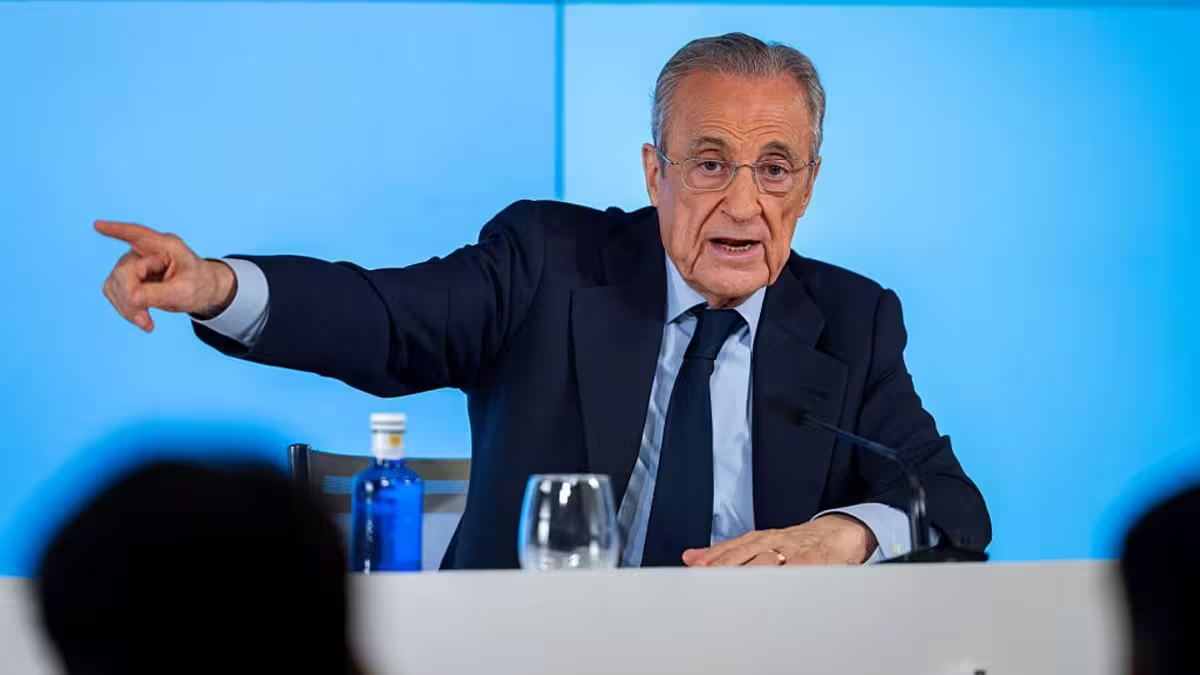
That technicality is where the contest acquires its immediate tension. Perez did not need to call an election now — he holds an active mandate that runs until 2029 — and Real Madrid’s statutes allow an incumbent to remain in office during the election process. Calling a vote while retaining an active mandate leaves open questions about motive and timing and raises obvious strategic advantages for an incumbent who remains in place while rivals prepare bids.
The club has set practical arrangements with members in mind. Shuttle services will run to Valdebebas because the visit of Pope Leo XIV to Madrid coincides with the vote and is expected to cause significant transport disruption; the pontiff will hold a mass at Plaza de Cibeles on Sunday. Those logistical details were flagged by the club ahead of the vote so members can plan whether to mail ballots or travel in person.
Potential candidacies have already surfaced in public comments. Enrique Riquelme, the 37-year-old founder of renewable energy company Cox Energy, said on Spanish television this week that he would sign Erling Haaland from Manchester City if made president — a throwaway line that illustrates how pledges during a candidate window can quickly become headlines and campaign promises.
What happens next matters as much as Sunday itself. The ten-day period for presenting bids begins when the call is formalised; after that the electoral board must determine which names are allowed on the ballot. Only if two or more candidacies pass that scrutiny will members actually choose a new president at Valdebebas or by post.
The immediate unresolved question is procedural and decisive: which, if any, challengers will be formally accepted once the candidacy window closes? The election has been scheduled; the contest is not yet guaranteed. The electoral board’s vetting of nominees will decide whether the rare spectacle of a contested Real Madrid presidential election — the first in two decades — actually takes place.



