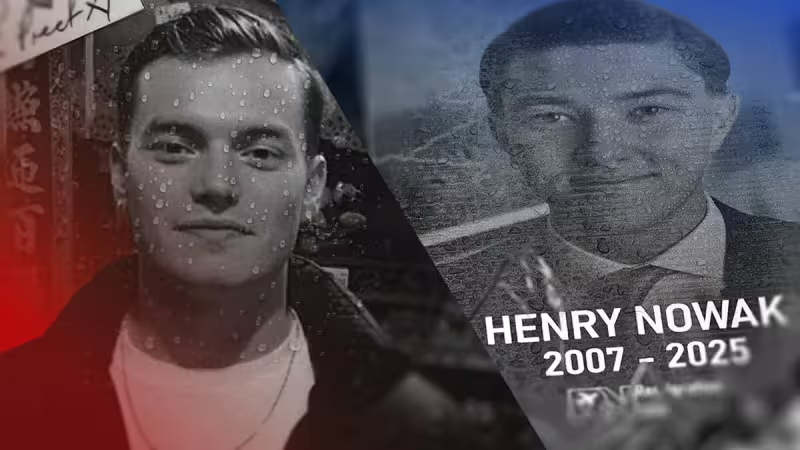
Far-right politicians in Poland, France, Spain and Japan used the killing of Henry Nowak to press anti‑immigration and anti‑anti‑racism arguments after police footage showing Nowak’s final minutes was shared around the world.
Nowak, 18, was stabbed five times in December and handcuffed by officers as he lay dying; his attacker, Vickrum Digwa, was this week jailed for life with a minimum term of 21 years.

The case has been repurposed within hours of the sentencing. At an activists’ meeting in Hammersmith last week, Marta Czech called for a "defence of Poles in our country and abroad" and warned: "We don’t have politicians who will care about Polish interests, or Poles, who will represent our values abroad, people with a Polish face, with a Polish passport. We need to be ready to repress these attacks. We must unite against such attacks."
Other public figures offered sharper, nationalist readings. Ewa Zajączkowska‑Hernik described Digwa as "an Indian" and wrote online: "This story symbolises Britain’s descent into the depths of the earth … How brainwashed do you have to be with leftist propaganda and political correctness to react this way? And how can you even bring your country to such a state with mass immigration that undermines security?" She added: "White lives don’t matter? Has the world reached this point, brainwashed by this suicidal, leftist ideology?"
In France, Éric Zemmour framed the killing as a symptom of political failure: "This horrific murder is a metaphor for what the West is experiencing: the native is treated as a suspect, while the immigrant perpetrator is shielded by the religion of anti‑racism, which paralyses government officials and police officers. This time, there will be no kneeling. Europeans, in their own homeland, are not allowed to do so." In Spain, Santiago Abascal wrote that "the British people are burning with rage" and accused "the mainstream media, silent, as usual... The globalist elites who have spawned this madness, also looking the other way. There are many responsible parties and accomplices in the atrocities we see daily in Europe. They should all be brought to justice, and one day they will be." In Japan, the publisher Hoshu‑Sokuhou ran the story as "a concrete example of the failure of multiculturalism."
The spread of the police footage — which shows Nowak’s final few minutes after he was stabbed — amplified the political impact. The images moved quickly from court reporting into social feeds and then into messaging from politicians who used the case to argue wider points about immigration, policing and cultural change.
The timing sharpened the effect: Digwa’s sentencing came this week, and Mr Nowak’s father, Mark, who is understood to be of Polish descent, asked that his son’s death not be politicised. "We do not want his death to be used to create further division, hatred or tension," he said, adding: "We want his story to make our streets safer for everyone." The family request has not stopped the overseas amplification.
There is a further legal and factual gap that has particular significance for the competing narratives. Police records show Digwa told officers he had been racially abused; later material establishes that Digwa lied to police about that claim. What specific evidence, interactions or findings led Digwa to tell police he had been racially abused has not been disclosed, and no additional court hearings on that point have been reported.
That unanswered detail matters because the claim of racial abuse is the hinge on which the case has been turned into a wider argument about race and immigration. With Digwa imprisoned for life and no further legal action confirmed, the most consequential question left for investigators and authorities is whether they will set out what prompted his false allegation — a clarification that could undercut or inflame the political readings now circulating abroad.