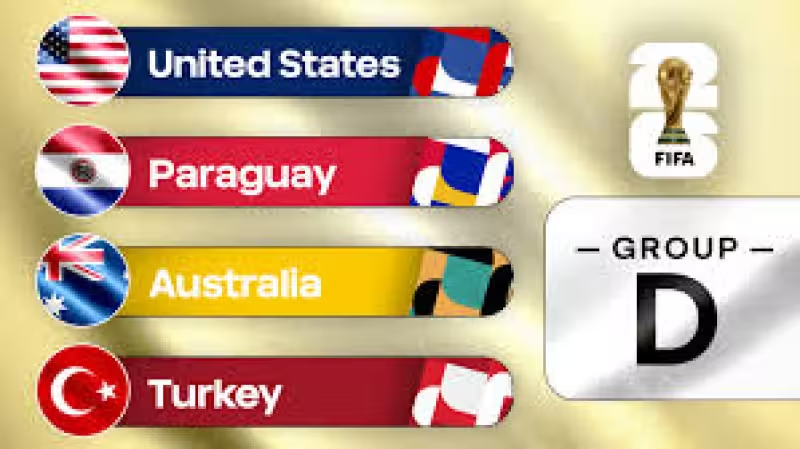
Group D at the 2026 FIFA World Cup is settled: host nation USA will meet Australia, Paraguay and Türkiye in the first round of the expanded tournament. The draw gives each side a clear set of adversaries and a snapshot of the path that leads from group play into the knockout phase.
The numbers make the stakes simple. The top two teams in each group move on automatically, and the tournament’s expanded format means the top eight third-place finishers also reach the Round of 32. The World Cup itself runs from June 11 to July 19 across the United States, Mexico and Canada, so every match in Group D carries immediate qualification value as part of a wider 48-team field.

For the USA the draw is confirmation of a familiar role: host and favorite. The United States will be making its 12th World Cup appearance and will host the tournament for the second time after 1994. Historically the USMNT’s best-ever finish came in the inaugural 1930 edition, when they placed third, while the best result of the modern era was a quarterfinal run in 2002; the team has reached the Round of 16 in each of its last three World Cup appearances.
Paraguay arrive in Group D having ended a 16-year absence from the World Cup. The 2026 tournament will be Paraguay’s ninth appearance and their first since 2010, a year in which they reached the quarterfinals — the nation’s best performance to date. Australia bring continuity: seven overall World Cup appearances and qualification for every edition since 2006, with Round of 16 showings in 2006 and 2022. Türkiye qualify for only their third World Cup, ending a 24-year drought since 2002, a tournament in which they reached the semifinals and finished third overall.



Context sharpens the shape of the group. The 2026 World Cup is the first 48-team edition, and that expansion is the mechanism that makes Paraguay’s path plausibly realistic: an underdog description sits atop a mathematical route into the knockout phase. The USMNT are widely regarded as the likely favorite in Group D, Türkiye carry a history of a deep run that marks them a possible dark horse in major tournaments, and Australia’s recent consistency gives them a baseline expectation of competitiveness.
The main friction in Group D is this: Paraguay are described as underdogs, yet they have reason to be quietly confident in at least a third-place finish — and that third place could be enough to push them into the Round of 32 under the tournament’s enlarged format. That complicates a simple narrative that places the United States and Australia above Paraguay and reduces Türkiye to a longshot; historical flashes — Paraguay’s 2010 quarterfinal, Türkiye’s 2002 semifinals — create outcomes that the rankings alone do not capture.
Practical detail for fans and planners: matches for Group D will occur within the tournament window of June 11 to July 19, and every point takes on extra weight because eight third-placed teams will survive the group stage. Home-field advantage for the USA is a built-in factor, but the math of third-place qualification means a single draw or surprise result could tilt who advances. The presence of Australia’s steady World Cup record and Türkiye’s tournament pedigree ensures Group D will present more than one plausible path into the knockouts.
The unresolved question that will make this group watchable is straightforward and consequential: can Paraguay translate underdog status into a top-three finish and thereby seize one of the available third-place slots that lead to the Round of 32? How they perform against the USA and Australia — and whether Türkiye can recapture the form that earned a podium finish in 2002 — will determine whether Group D finishes predictable or becomes one of the tournament’s early storylines.