



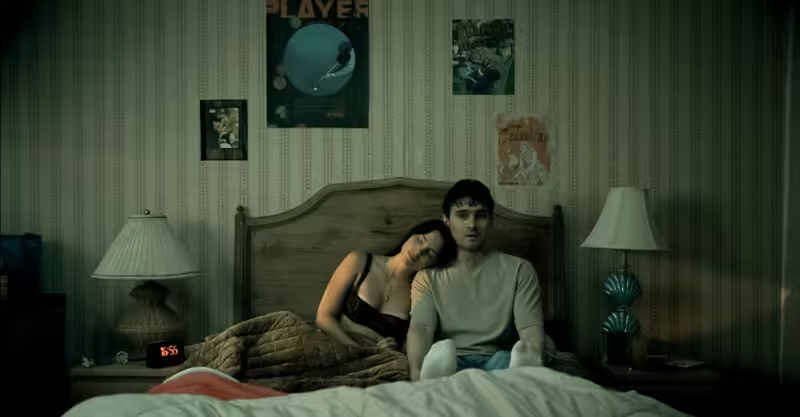
In Obsession, Curry Barker’s feature debut, a single wish makes a shy record-store clerk’s crush erupt into nightmare: Bear uses a One Wish Willow to wish that Nikki will love him more than anything, and Nikki quickly becomes violently possessive.
The film, directed by Barker, 26, stars Michael Johnston as Bear and Inde Navarrette as Nikki; it stages the collapse of a small, anxious world with vivid, unsettling details. After the wish, Nikki duct-tapes Bear’s front door shut, stuffs flesh from his dead cat into his sandwiches and watches him sleep from dark corners. Bear’s inability to answer a direct question—he literally freezes when Nikki asks whether he likes her—anchors the early scenes. Megan Lawless plays Sarah, a co-worker who gets to the brink of confessing that she likes Bear before the supplied scene cuts away.

Those set pieces are the weight of the film: they prove this isn’t a coy romance or a cautionary comedy. Barker weaponizes teenage-era dread—fear of confrontation, fear of being trapped—into physical, escalating terror. The One Wish Willow is the mechanism, but the engine is that avoidance: the wish does not create genuine connection, it shortcuts it, and the result is cruelty that the camera treats with an almost clinical stubbornness.
Obsession dramatizes a Gen Z anxiety spiral rooted in fear of being trapped by social fears. The movie links that spiral to the surveillance-like habits and instant-gratification cycles of smartphones and social media, portraying a generation that often recoils from dating, sex and direct intimacy. Barkers’ horror comes less from monsters and more from an inability to speak plainly: honesty is not rewarded in the film, and the wish functions as a dangerous, passive attempt to skirt an awkward conversation.


That framing is deliberate and also complicated. The film depicts clear acts of intimate violation—possession, stalking, tampering with a body’s remains—but Barker’s storytelling leans toward an anxiety parable rather than an explicit commentary on intimate-partner abuse. The result is a friction the movie refuses to smooth over: viewers can read Nikki’s behavior as the literalization of social-media-fueled possessiveness, or as a straightforward depiction of escalating abuse. Both readings fit the facts on screen.
The practical consequence is immediate and disquieting. Bear’s paralysis—the sweaty rehearsal of a confession, the freeze when asked the question—becomes the engine of his undoing. Sarah’s interrupted confession later in the film underlines the same point: attempts at honesty are cut off, abandoned or rendered meaningless by the wish’s violence. Barker stages those cutoffs as moral failures with material costs, not simply awkward personal moments.
What will decide how Obsession 2026 lands is which frame viewers bring to it. Barker foregrounds the wish and the social-avoidance mechanics that produce it; he asks the audience to see the horror as the extrapolation of a particular, generational awkwardness. But the film’s visceral, concrete violations will ensure many viewers treat it as an intimate-partner-abuse story as well. Those two responses are not mutually exclusive; they point to different moral emphases.
Obsession 2026 makes a clear artistic choice: it stages a modern parable about silence and the cost of not speaking up. As a result, the movie will probably register first as a Gen Z anxiety story for viewers attuned to social-media culture, and as a raw depiction of possessive violence for those who watch for power and control. That split is the movie’s point—Barker offers no neat answer about which reading is the only right one, only a relentless demonstration of how an avoided conversation can become horror.



