
The U.S. economy added 172,000 jobs in May, and the unemployment rate remained unchanged at 4.3%, a payroll surprise that far outpaced economists’ median forecast of 88,000 and immediately reshaped market and policy discussions.
The size of the surprise is underscored by upward revisions to prior months: April’s gain was revised to 179,000 from the 115,000 initially reported, and March’s payrolls were revised to 214,000 — the first monthly increase above 200,000 since early 2024. Private payroll data from ADP showed 122,000 jobs added in May, with hiring spread across eight of the 10 supersectors the firm tracks.

Those figures suggest broader underlying momentum in hiring. A separate, earlier signal showed job openings had soared to 7.62 million the month before, an indicator that employers still have roles to fill even as headline hiring ebbs and flows.
Still, the May numbers land against a conflicting signal from the Federal Reserve’s Beige Book for May, which reported that employment showed little to no change in 11 of the Fed’s 12 districts. The Beige Book described a low-hire, low-fire environment where employers were increasingly reluctant to change jobs because of economic uncertainty and where hiring remained selective, focused mainly on critical roles or replacing attrition.


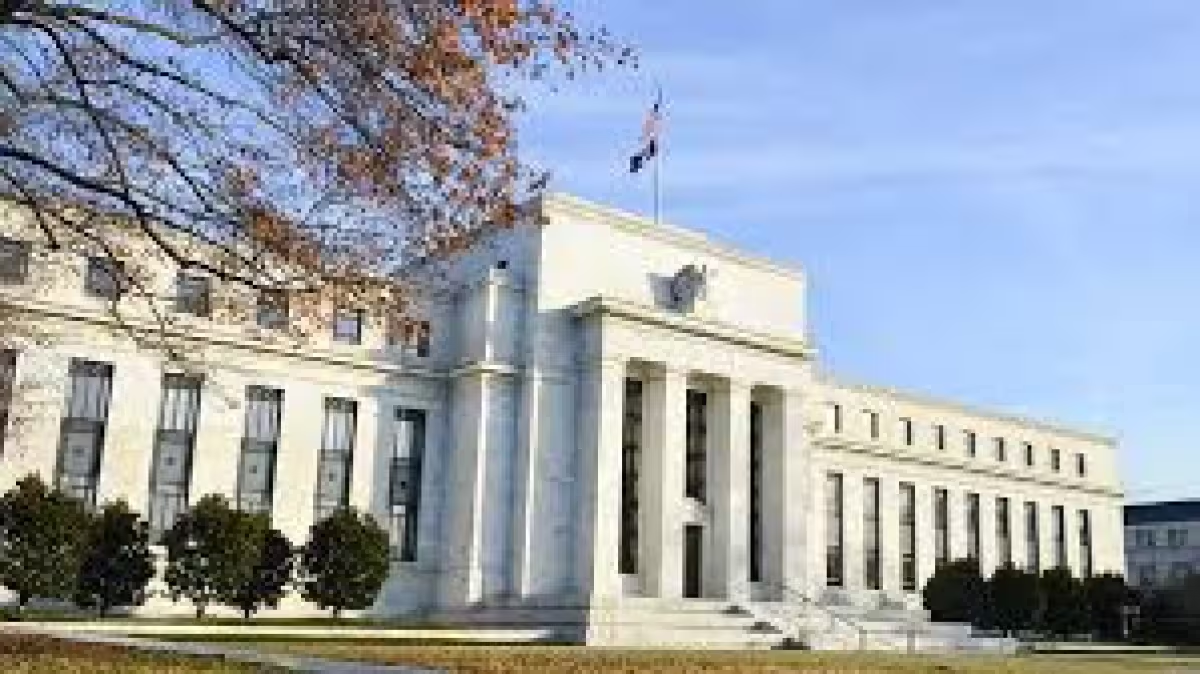
The split matters because it forces a choice for economists, traders and the Federal Reserve alike: treat the 172,000 gain as evidence that the labor market retains unexpected strength, or view it as an outlier within a broadly stagnant hiring landscape. Markets and comment threads on forums such as Forex Factory will parse the details, but the data themselves already push against the slower hiring picture painted by the Fed’s regional contacts.
For policy, the immediate implication is straightforward: stronger-than-expected payroll growth tightens the case for officials to remain cautious about declaring victory over inflation. The report strengthens the argument that labor demand — and therefore wage pressures — may prove stickier than some forecasts assumed. At the same time, the Beige Book’s account of selective hiring and worker reluctance to move tempers the narrative that the job market is broadly overheating.
Analysts will watch the composition of the May gains for more clarity — which sectors produced the bulk of the 172,000 hires, and whether wage acceleration accompanies the topline gains — but the revisions to March and April already rewrite recent momentum. April’s upward revision from 115,000 to 179,000 and March’s move above 200,000 remove the cover that smaller monthly gains had offered policymakers in previous weeks.
The report leaves a sharper, operational question in its wake: how will the Federal Reserve interpret this mixed record when it next evaluates policy? The data give officials ammunition to argue that the labor market still has enough heat to justify vigilance. Yet the Fed’s own regional reports suggest many districts see little change and employers exercising caution. That contradiction — a robust national payroll gain amid regionally tepid hiring — is the central unresolved fact policymakers must square before the next rate decision.
Whatever conclusion Fed officials draw, the May payrolls will reverberate in economic forecasts, investor positioning and trading communities such as Forex Factory, where participants will be recalibrating odds for future interest-rate moves. The most consequential open question now is not whether jobs were created in May, but whether this pattern marks a renewed upswing or a one-off deviation from an otherwise subdued hiring backdrop.