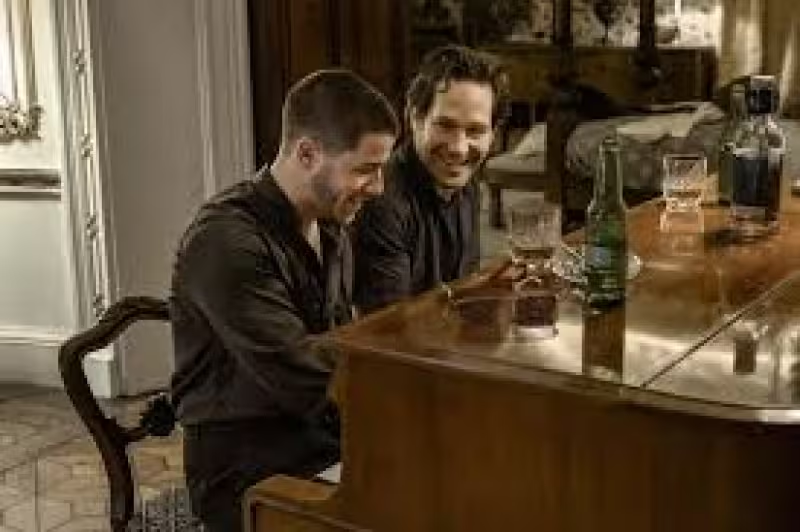
A recent review delivers a clear result: John Carney’s Power Ballad is built around the pairing of Paul Rudd and Nick Jonas, and it stays true to Carney’s long habit of using music to remap ordinary lives rather than to manufacture celebrity. The film foregrounds a wedding-band singer and a pop star who cross paths, and the staging of that meeting is the film’s primary dramatic engine.
The review puts the band at the center of the story. Called Bride and the Groove, they speak for themselves with a single, self-aware line: "They’re not rock stars. They’re human jukeboxes." That admission frames nearly every scene that follows, and it underlines the movie’s modest ambition—Carney is less interested in launching careers than in showing what small, everyday music-making does to people.

Paul Rudd appears as the wedding-band singer who embodies that modesty; Nick Jonas plays the pop star whose world briefly overlaps with the band’s. The collision between the subdued, service-oriented life of Bride and the Groove and the spectacle associated with a pop figure provides the film’s essential friction. The contrast is deliberate: a band that insists it is not rock-and-roll meets a performer whose profession implies larger-than-life status.
The review notes tonal choices that underline Carney’s intentions. Power Ballad "starts like a fairy tale," setting up a feel-good surface that Carney then complicates with the quotidian details of wedding gigs, cover sets and the compromises that sustain a working band. Those specifics are evidence that the movie wants to examine the dignity and limits of communal music rather than stage a conventional rise-to-fame narrative.



Carney’s authorship matters to the verdict. Since 2007, when Once signaled his interest in music’s redemptive capacity, he has returned to similar territory in films including Sing Street and Flora and Son. He was once a bassist for the Frames, and that personal history shows up in Power Ballad’s sympathy for musicians whose work happens on small stages and in living rooms rather than on stadium marquees.
The review’s strongest illustrative detail is the band’s self-description as "human jukeboxes." That line does more narrative work than any promise of stardom: it explains why the film resists the glamor of pop success and instead lingers on the strip-mall, reception-hall routines that sustain the band. Dropping a bona fide pop star into that world creates awkwardness rather than instant uplift, and much of the movie’s interest comes from watching how the characters navigate that awkwardness.
But the review leaves a consequential blank. It describes the moment when the wedding-band singer and the pop star cross paths, and it stops short of mapping how that meeting reshapes the band’s arc. There is no clear roadmap in the review for whether the encounter resolves into transformation, compromise, or simple return to the status quo. That omission is the movie’s central loose end as presented here.
Given Carney’s track record and the film’s tonal choices, the prudent reading is that Power Ballad uses the pairing of Rudd and Jonas to ask whether a brush with fame can alter a life built on routine music-making, not to chronicle a classic breakout story. The review implies Carney is interested in the small consequences of music—repair, connection, temporary illumination—more than in producing a triumphant finale.
The immediate practical gap is distribution: the review does not confirm when or where audiences can see Power Ballad. For now the takeaway is simple and specific: Paul Rudd and Nick Jonas headline a John Carney picture that prefers the human jukebox to the rock star, and the lingering question—how much that meeting changes anyone—remains intentionally unresolved until the film reaches viewers.