



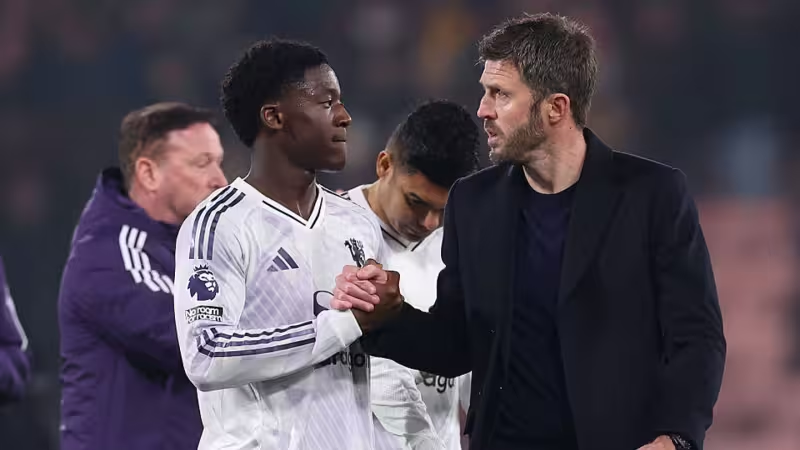
“Definitely, and I told him that I was very grateful. Because if he hadn’t put me on the pitch, then I wouldn’t have been here so, I’m always grateful to him for that,” Kobbie Mainoo said from England’s World Cup camp, naming Michael Carrick as the decisive factor in his return to international reckoning.
The 21-year-old’s gratitude is concrete: Mainoo did not start a Premier League game this season until Ruben Amorim was sacked in January, and Carrick immediately reinstated him to the starting XI. Mainoo’s form in the second half of the campaign — he featured in 16 of 17 possible games after Carrick took charge — helped Manchester United climb to third in the table and was the clearest reason he earned a place in England’s World Cup squad.

Mainoo linked that run of club minutes directly to his national selection. In the March international break, Thomas Tuchel selected Mainoo for England, and the midfielder says the sequence — Carrick handing him consistent starts, a strong finish to the season and renewed confidence — led to his World Cup inclusion this summer. “So to be here and say that I’m playing in a World Cup is unbelievable,” he added.
There is history behind the headlines. During Euro 2024 Mainoo started in the final against Spain and arrived at this tournament with a reputation established at senior international level. At club level, however, the season had a jagged midsection: Mainoo has acknowledged he “had difficult times” during Amorim’s tenure, and he revealed he had hoped to leave Manchester United on loan in the final week of last summer’s transfer window — a request the club rejected.
That contrast is the weight of the story: a player who was out of favour and pushed for a temporary move ended the season with a new five-year contract and a World Cup call-up after a change of manager. Mainoo described the reception to Carrick’s appointment in club circles: “We were very happy with it, obviously, I love the way he coaches and manages me personally in the team as well. I think everyone in the squad can agree with that. When he officially got the job, we were all so happy.”
Mainoo’s resurgence was not only personal. His return to the starting eleven helped United secure Champions League qualification with a third-place Premier League finish, and his second-half performances convinced England’s staff he belonged back in the squad for 2026. On the pitch, Mainoo has been clear-eyed about the team’s ambition: “I feel like everyone in the squad, staff, everyone believes we can win it,” he said, adding the simple affirmation, “One hundred per cent.”
The friction in Mainoo’s account is small but sharp: the same club that refused his loan request also handed him a long-term deal to safeguard his future at Old Trafford. It is a tidy resolution for the player but an awkward one for the club’s continuity — Mainoo’s national breakthrough has been tied directly to the manager who restored him to the team, and his gratitude makes that link public.
The single most consequential unanswered question now is managerial: will Carrick be retained permanently as United manager, and if he is not, who will decide Mainoo’s role next season? Mainoo leaves for the World Cup with form and a contract, but his immediate future at Manchester United remains hostage to a decision the club has yet to resolve — and that decision will determine whether the run that returned him to England endures or needs to be won again.



