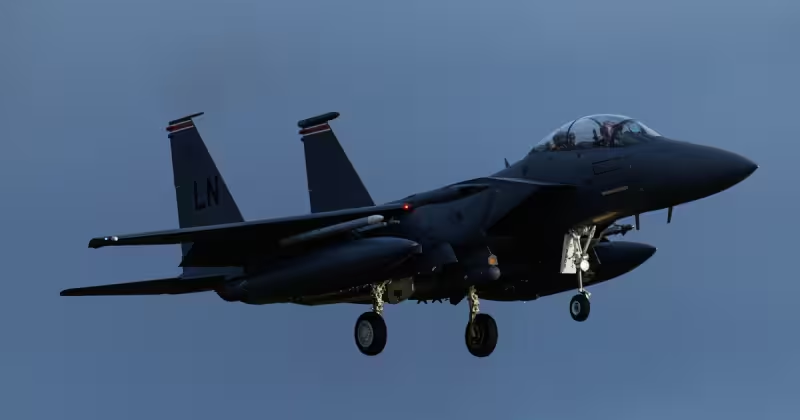
U.S. officials are investigating whether an American F-15E Strike Eagle shot down over southwestern Iran in April was struck by a Chinese-made shoulder-launched missile, a development that would mark the first time in decades a U.S. fighter was downed by enemy fire.
Three people with knowledge of the matter said the aircraft was probably hit by a Chinese-made man-portable, shoulder-launched missile roughly 7 feet long and about 40 pounds. The plane’s two-man crew ejected safely; the pilot was rescued within seven hours, and the weapons systems officer was located and recovered two days later after hiding in the foothills of the Zagros Mountains, the Pentagon said.

The immediate consequence was a dangerous, time-sensitive rescue operation across hostile territory. The downing set off searches that reached into the rugged Zagros foothills, where the weapons systems officer sheltered until rescuers could extract him. Officials say the rescue underscored the risks U.S. forces have faced while carrying out what Washington described as defensive strikes in the same theater.
President Donald Trump said at the time that the F-15E was struck by a shoulder-launched missile, repeating a claim that has become central to the inquiry: "President Xi has promised me that he’s not sending any weapons to Iran. That’s a beautiful promise. I take him at his word. I appreciated it," Trump said in public remarks that also referenced diplomatic talks with China.
That public assurance collides with other threads in U.S. reporting. One source and a U.S. official with knowledge of intelligence reporting said China may have provided Iran with a long-range early-warning radar in the early days of the conflict, and U.S. intelligence suggested China was planning to supply new air-defense systems to Iran in the coming weeks. At the same time, the Chinese Embassy pushed back, saying: "China always acts prudently and responsibly on the export of military products, and exercises strict control in accordance with China’s laws and regulations on export control and due international obligations. China opposes groundless smear and ill-intentioned association."
The contradiction is the core friction in the inquiry. U.S. investigators are treating the probable Chinese-made missile as a lead—not proof of direct Chinese transfer. They are tracing serial numbers, battlefield recovery evidence and supply chains to determine whether the weapon came from China, from intermediaries, or from third-party sellers in the region. Those provenance questions will shape how Washington responds diplomatically and militarily.
Senator Marco Rubio reacted to the report by urging a broader U.S. response, saying, "They’ve got to get involved in this as well." Rubio also framed the political stakes toward Beijing: "We’re not asking for China’s help. We don’t need their help," he said, pressing for accountability that stops short of relying on Chinese cooperation.
Investigators face several concrete gaps. Officials have not confirmed the final provenance of the shoulder-fired missile, and they have not publicly released forensic evidence linking it to a specific manufacturer or export chain. U.S. sources say the weapon’s probable Chinese design is enough to demand a deeper, classified review of logistics and shipments into Iran since the conflict began.
The matter matters now because the determination will affect U.S. diplomatic posture toward China and the rules of engagement in an active theater. If evidence shows a direct Chinese transfer, Washington could treat the shootdown as part of a broader escalation that redraws the line between sale and direct support. If the trail leads to intermediaries or local procurements, the policy choices will be narrower but still consequential.
U.S. officials stressed that the investigation remains active. The most consequential unanswered question is whether the shoulder-launched missile was transferred to Iran directly by China or arrived through secondary channels—an answer that will determine whether this shootdown is an incident in a conventional conflict or a flashpoint in great-power competition.