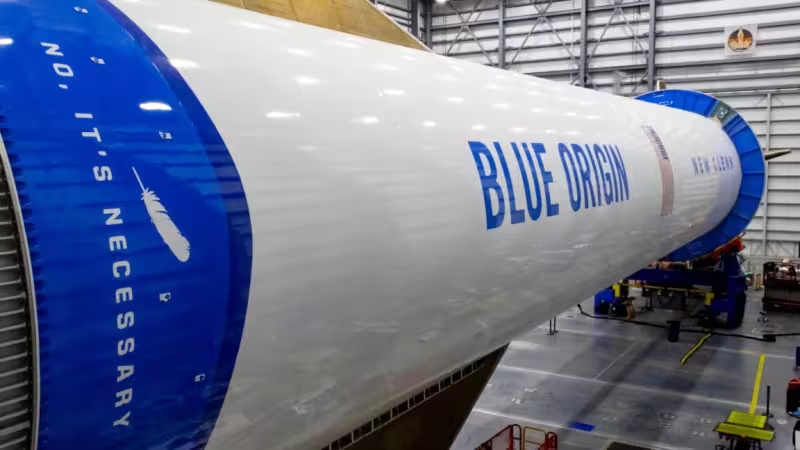
Blue Origin has closed its investigation into the failure on the third flight of New Glenn, and federal regulators approved the report on May 22, putting the heavy-lift rocket on track for its next launch. Public airspace and maritime closure notices suggest the vehicle could lift off as soon as Thursday, June 4, if the company completes the remaining steps before flight.
The April 19 NG-3 mission left AST SpaceMobile’s BlueBird 7 satellite in an orbit too low for recovery after New Glenn’s second stage, GS2, ran into trouble on its second burn. Blue Origin said one of the BE-3U engines did not achieve full thrust before the burn ended, while the Federal Aviation Administration said the direct cause was a cryogenic leak that froze a hydraulic line and triggered a thrust anomaly during the second-stage engine burn. Blue Origin said it identified nine corrective actions to prevent a repeat of the event.

That failure mattered because it came on the rocket’s third flight, a moment when New Glenn was trying to prove it could move from development setbacks to regular service. The first stage did land on Blue Origin’s floating platform, Jacklyn, on April 19, but the mission still ended with the second stage and its payload stranded short of the orbit needed to recover the spacecraft. AST SpaceMobile later said BlueBird 7 would be deorbited.

The FAA said it will verify that Blue Origin implements the corrective actions before the next New Glenn mission. The company has said it is preparing for NG-4, but it has not disclosed a launch schedule or identified the customer. Blue Origin is expected to roll New Glenn to the pad for a test-firing of its seven main engines, a key step before launch.
For Blue Origin, the timing matters because the next flight is expected to carry 48 commercial satellites for Amazon’s broadband network, the largest satellite load Amazon has launched on a single rocket. The broader Amazon Leo constellation is expected to number more than 3,200 satellites, making New Glenn central to a program that needs reliable heavy-lift capacity. The company’s progress also lands against a wider backdrop in which ULA’s Vulcan has faced its own grounded period while investigators examine recurring solid rocket booster anomalies.
Scott Wisniewski of AST SpaceMobile said on an earnings call on May 11 that an upper-stage anomaly like this is not uncommon early in programs and that the company felt optimistic about New Glenn getting back to the pad soon. Blue Origin’s report and the FAA’s approval now turn that optimism into a practical test: whether the rocket can clear its fixes, survive a hotfire, and return to flight without repeating the GS2 failure. Dave Limp put it more plainly: “Next stop integrated hotfire.”