



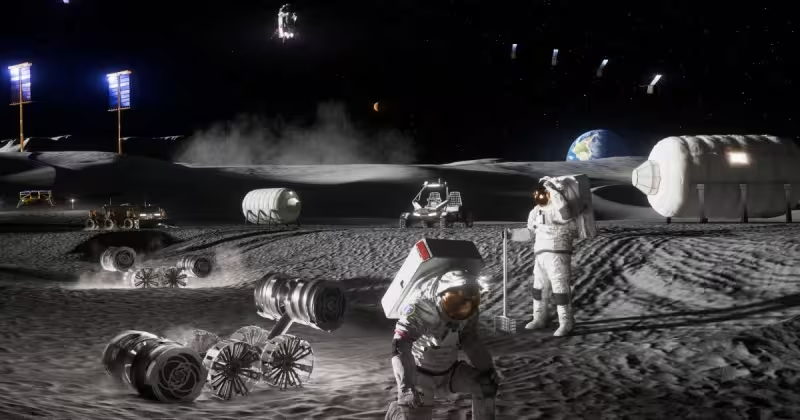
NASA on Tuesday announced plans for three uncrewed missions to the moon later this year as the opening moves in a multi‑phase effort to build a permanent base on the lunar surface.
Jared Isaacman, who briefed reporters alongside agency officials, framed the push as a deliberate, industry‑led ramp-up: "We are not jumping right into the glass dome moon base," he said, adding that the agency will "intend to take an iterative approach, sending a demand signal to industry for a lot of landers and rovers and tech demonstrations, and all the scientific payloads these missions can accommodate."

The missions—named Moon Base 1, Moon Base 2 and Moon Base 3—are all slated to launch by the end of this year, with Moon Base 1 targeted for no earlier than this fall. NASA said the flights will scout locations at the moon’s south pole, gather scientific data, test technologies and prepare for the return of astronauts to the lunar surface.
The size and scope announced Tuesday underscore how quickly NASA plans to press private partners into service. Moon Base 1, Isaacman said, "will be the first privately funded lunar lander mission in history." NASA also revealed that it awarded Blue Origin a contract to carry two science and technology payloads to the moon using its lunar lander.
Moon Base 2 will press heavier hardware to the surface: a lander built by Astrobotic is expected to transport more than 1,000 pounds of cargo and a moon rover. Moon Base 3, NASA said, will study enigmatic lunar swirls and deliver payloads from the European Space Agency and South Korea’s space agency.
Carlos Garcia‑Galan, outlining the agency’s timetable, said the first phase of the moon base plan is expected to last through 2029. "Phase one, for example, will have 25 launches, 21 landings, and we’re planning to deliver about 4 metric tons of cargo to the surface of the moon," he said.
NASA described this initial work as preparation: phase two, from 2029 to 2032, will assemble semipermanent facilities to enable early habitation, and phase three, beginning in 2032, will aim to achieve a sustained presence on the lunar surface. Isaacman tied the moon program to a broader ambition, saying the lunar base will help NASA hone skills needed to eventually venture to Mars.
Isaacman also put a price tag on the near‑term effort: "We’re talking about a $20 billion investment over the next seven years to establish that enduring presence on the moon," he said. That figure, he suggested, will flow through a mix of private funding, commercial contracts and NASA investment as the agency signals demand to industry.
There is clear tension in the plan. The announcement pairs an aggressive launch cadence—three uncrewed missions by year’s end and dozens of flights and landings through 2029—with a heavy dependence on nascent commercial landers and privately funded missions. Moon Base 1’s billing as the first privately funded lunar lander mission sits beside NASA’s decision to award Blue Origin a contract to carry specific payloads, highlighting how public and private roles will overlap and, at times, collide.
The schedule will test that partnership model. Pushing two distinct industrial programs—Blue Origin’s lander services and Astrobotic’s cargo and rover delivery—into simultaneous, end‑of‑year flight campaigns leaves little margin for slips. Success will mean the agency can move from scouting to construction on the compressed timetable it described; failure will force a reassessment of how quickly a demand‑signal approach can convert contracts and investments into reliable lunar logistics.
For now, the story returns to Isaacman’s insistence on pragmatism. By rejecting an immediate leap to an enclosed habitat and instead ordering a series of incremental missions, NASA has chosen a path that makes private companies such as Blue Origin and Astrobotic the linchpin of the agency’s next chapter on the moon. Whether industry can deliver on the cadence and mass figures Garcia‑Galan spelled out will determine whether the $20 billion plan over the next seven years becomes the foundation of a lasting human presence beyond Earth.



