



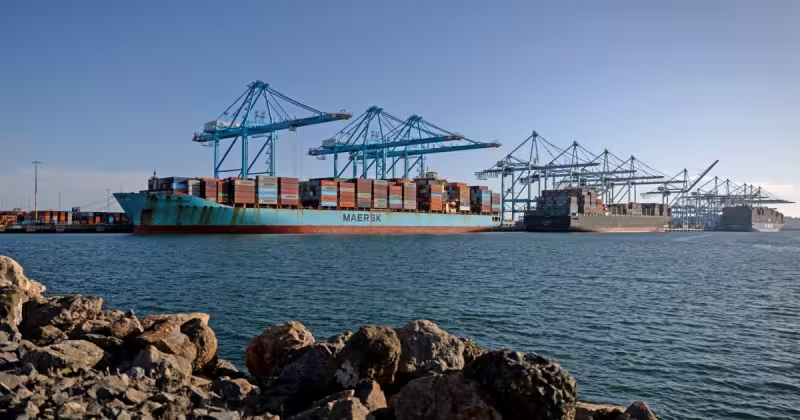
Brandon Lord said in a court filing Tuesday that the Trump administration has refunded more than $20 billion in tariffs to importers and shippers so far, part of a larger rollback ordered after the Supreme Court struck down the program in February.
The numbers in Lord’s filing make clear how large the reversal is: the administration had relied on the International Emergency Economic Powers Act to collect more than $165 billion in country-specific tariffs since the start of President Trump’s second term. Lord wrote that "Approximately $85 billion in both potential and certified refunds have been accepted for processing," and that, as of Friday, $20.6 billion of that accepted total had already been completed.

That progress does not mean the job is finished. Lord also told the court that "4,185 consolidated refunds have not been transmitted to Treasury" because importers failed to provide bank account information. Hundreds of companies have lined up to get money back — among them Costco, Walmart, Home Depot, Target, General Motors, Ford, FedEx, UPS and DHL — and some major retailers face the awkward choice of seeking refunds while remaining politically exposed. President Trump said last month he would "remember" which companies decided not to ask for refunds.
The refunds follow the Supreme Court’s finding in February that the country-specific tariffs exceeded what IEEPA permitted the president to do, forcing the administration to unwind a central piece of its trade policy. Importers remain subject, however, to a separate blanket 10% tariff imposed under Section 122 of the Trade Act of 1974, a short-term authority that allows the president to impose global tariffs of up to 15% for up to 150 days.
Within days of the court’s decision the president threatened to raise that duty to 15%, though he has not done so. Asked on Tuesday whether the administration could restart the 150-day clock under Section 122 without congressional approval, U.S. Trade Representative Jamieson Greer said bluntly that he could not see Congress moving to block a restart and pointed out ambiguities in the statute. "When you look at that statute, it says they expire but doesn’t say when you can redo it," Greer said, adding, "I might get in a little trouble here." He pressed the point further: "Whether the 122, you know, can be used — when it can be reused — I mean, I can’t imagine that Congress would say, well, this is just, you know, once per term, right?" He finished with a note of caution: "So I can’t really opine on it, beyond saying it doesn’t say you can’t reuse it. But it is temporary; there’s some tension in that."
The tension Greer describes is the story’s friction: the administration is simultaneously returning billions to importers while keeping in place (and signaling it might relaunch) a separate tariff that can bite U.S. companies and foreign suppliers. If the White House reissues a temporary global tariff, importers who have applied for refunds now face the prospect of immediate new duties; those that have not applied risk political fallout if they are seen as standing aside.
Trade lawyers and corporate counsels are preparing for both tracks at once — claims for refunds and contingency plans for higher duties — a split strategy that has global reverberations for supply chains already strained by political decisions and shifting tariffs (see Africa: China's Tariff Cutbacks and Diplomatic Pressure Leave Eswatini Isolated
The most consequential fact after this week is procedural: roughly $85 billion in refund claims are in the administration’s pipeline, and $20.6 billion has already reached bank accounts. The administration has returned a large chunk of money, but it is also signaling it can, under Section 122, relaunch a temporary global tariff that could impose up to 15% duties for 150 days — a move that would reset pressure on the same companies now waiting in line for refunds.



