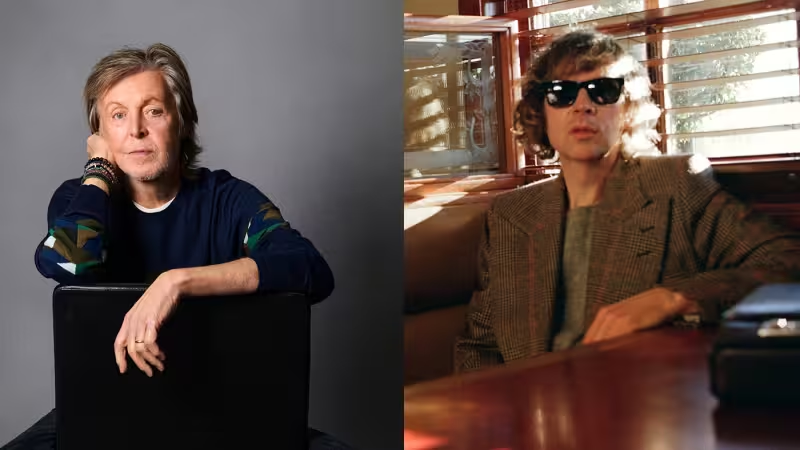
Paul McCartney sat down with Grayson Haver Currin for a MOJO world‑exclusive published today that retraces the 70‑year journey behind his new album, The Boys of Dungeon Lane, and the memories that shaped it.
The interview follows McCartney from his childhood in Liverpool through The Beatles and Wings, and drills into the emotional history behind songs on the record. MOJO’s feature also includes a month‑long celebration of McCartney that has prompted musicians to single out tracks; Beck, for example, selected "Arrow Through Me" as his favourite post‑Beatles McCartney track and called it "one of McCartney’s unsung gems from the ‘70s."

Beck went further: "one for the heads," he said, adding, "There’s just a hint of punk and new wave seeping in" and, plainly, "I’ve never thought McCartney has received enough credit for his use of brass." Those lines sit inside a package that treats the new album as the endpoint of a seven‑decade arc — and as a prompt for fans and local institutions to revisit the past.
One of those institutions, the Jacaranda in Liverpool, has temporarily renamed itself The Maccaranda and announced on Instagram that it had teamed with McCartney. "In celebration of our former performer and customer’s new album, The Boys of Dungeon Lane, out 29 May, we’ve temporarily changed our name," the venue wrote, and invited patrons to "Pop by The Maccaranda and try Paul’s own cocktail, the Maccarita." The venue said it will host a The Boys of Dungeon Lane pre‑release listening party on Friday and is selling a special edition of the album in black or pink vinyl that includes a 1960 replica Jacaranda Club membership card.

The tie‑in echoes the Jacaranda’s long history: it opened in 1957 and was a haunt for a young John Lennon, Stuart Sutcliffe, George Harrison and Paul McCartney. The venue’s proprietor Allan Williams later became the band’s unofficial manager, arranged their 1960 residency in Hamburg and introduced them to their future drummer, Ringo Starr. McCartney’s new album, the interview makes clear, features songs about that childhood and those early adventures with Harrison and Lennon.
There is a clear line between the MOJO interview and the Jacaranda’s rebrand: one is a long‑form reckoning with a 70‑year musical life, the other a local celebration timed to a May 29 release. That alignment is mutually useful — the magazine gives readers context and testimony, and the venue offers a physical, celebratory moment — but it also exposes a tension between introspection and promotion. The magazine’s principal focus is McCartney’s musical reflections; the Jacaranda’s move is explicitly promotional, selling limited‑edition vinyl and staging an event that packages nostalgia as a product.
Still, the human story remains central. Currin’s interview makes the record feel like a catalogue of place and memory, not a publicity stunt: details about Liverpool streets, rehearsals and the young bandmates who would become The Beatles thread through the conversation. Beck’s selection of "Arrow Through Me" — and his remark that it contains the faintest whiff of punk and new wave while underscoring McCartney’s brass savvy — underlines how artists are reading McCartney’s past for musical clues, not just marketing cues.
What happens next is simple and immediate: The Boys of Dungeon Lane arrives 29 May, the Jacaranda hosts its pre‑release party on Friday and fans will judge the record by its songs more than by the publicity around it. The MOJO interview and The Maccaranda’s festivities amplify each other, but the record’s reception will rest on whether listeners find the emotional through‑line McCartney describes. If the interview is any guide, McCartney has given them the map; the question now is whether the album itself rewards the attention.