



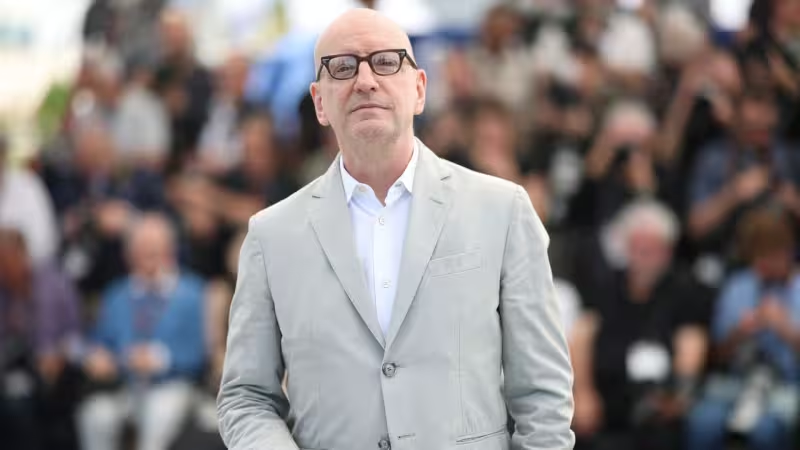
Steven Soderbergh has built a film around the last radio interview John Lennon and Yoko Ono gave on the morning of December 8, 1980 — the same day Lennon was killed — presenting the full, two-hour-and-45-minute conversation in sequence and surrounding it with more than 1,000 archival images and carefully chosen visual material.
The documentary, titled John Lennon: The Last Interview, uses the recording that, until now, had never been accessed in its entirety. Soderbergh said of finding the tape, "How little we expected" and later called the discovery, "the creative equivalent of finding this Spanish galleon sunken off the coast of wherever and it’s filled with, like, gold coins." He added, "I just couldn’t believe it."

The scale is plain on the screen and in the credits: the conversation lasted two hours and 45 minutes; the film is built from more than 1,000 archival images; and roughly about 10% of the finished film uses AI-assisted sequences created in partnership with Meta. Those sequences — flowers blooming, cavemen, babies crying — are slotted into moments when Lennon was speaking in a more philosophical register, material Soderbergh described as "thematic surrealism."
Context matters here. The interview was the only radio interview Lennon and Ono gave to promote Double Fantasy, which had been released three weeks earlier. A small crew from San Francisco’s KFRC radio station recorded the conversation in the Dakota Building apartment in New York. After Lennon’s death later that day, only excerpts were broadcast; the full tape had not been opened up until Soderbergh’s production, which used archival material from the Lennon estate and from Sean Lennon.
The film’s approach is deliberately chronological. "I wanted to respect the chronology of the conversation because there was a structure and a rhythm," Soderbergh said, and that decision drives the documentary’s architecture: archival photos and the newly rendered imagery appear around the audio rather than interrupting it. Soderbergh has said the audio itself was in good condition because it was recorded using the best equipment available at the time, and that fidelity allowed him to preserve the flow of the exchange.
That fidelity does not remove friction. Soderbergh’s use of AI — even confined to about 10% of the runtime and reserved for abstracted passages — attracted attention after the film debuted at Cannes. He defended those choices in interviews, saying the AI material served moments when Lennon reached for broader metaphors rather than specifics. Soderbergh also emphasized he had consulted with Sean Lennon: "We met with Sean Lennon and he trusted us," he said, framing the production as collaborative with the family who controls much of the archival permission.
The documentary is as much archival excavation as artistic interpretation. Soderbergh leaned on the tape’s unedited chronology to show a conversation whose rhythm and unexpected turns have been obscured since December 8, 1980. He told listeners that the discovery felt revelatory: the finding produced a mix of astonishment and stewardship — "I just couldn’t believe it," he said again — and an obligation to present it whole.
For viewers seeking a new window on a day that reshaped rock history, the film delivers the complete morning exchange in the form Soderbergh says best preserves its meaning: the raw audio, a vast photographic archive, and limited, deliberate AI-driven imagery that he argues clarifies rather than distorts. After his Cannes screenings and conversations defending the choice to use modern tools, Soderbergh’s position is clear — he has offered what he calls the definitive presentation of that last interview, framed chronologically and augmented only where abstraction seemed necessary.
Seen this way, the documentary answers the simplest question the headline raises: it does not replace the recording with invention; it presents the full morning conversation as a document and adds interpretive visuals in a tightly contained share of the film, leaving viewers with an unbroken hearing of Lennon on the morning of December 8, 1980 and a curated visual landscape meant to illuminate, not overwrite, what he said.



