

























New sabre-crested Spinosaurus species named from Sahara desert fossils

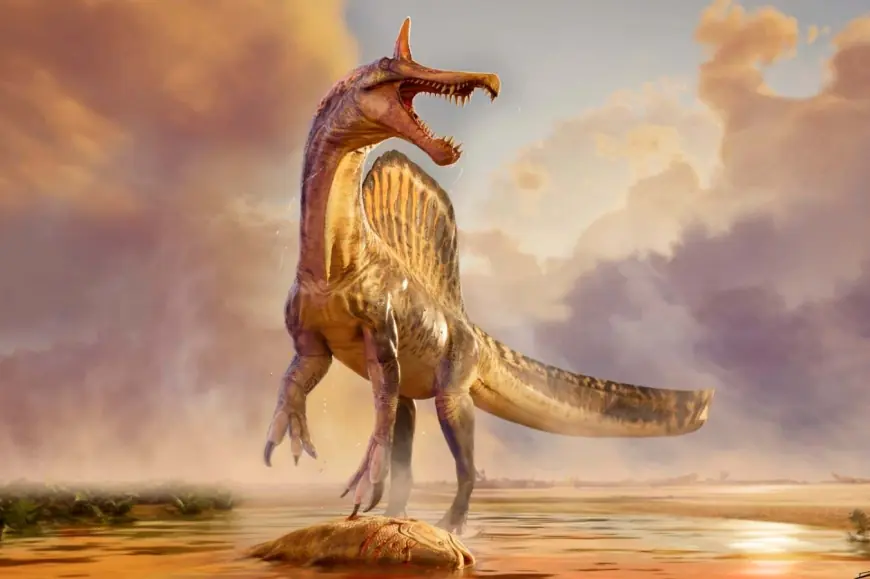
A striking new species, Spinosaurus mirabilis, has been identified from fossils unearthed in the Sahara Desert, and researchers say the discovery sharpens understanding of how these sail-backed dinosaurs lived and displayed themselves. The find is based on multiple specimens and reveals an unusually large, curved cranial crest coupled with the familiar dorsal sail.
What happened and what’s new
Researchers named a new species, Spinosaurus mirabilis, from fossils recovered in what is now the Sahara Desert. The material dates to roughly 95 million years ago and includes skull remains that preserve a distinctive scimitar- or sword-shaped crest on top of the head. The bony portion of that crest on large individuals would have been at least about 40 centimetres high and was likely extended in life by a keratinous sheath, making the living crest substantially taller.
The excavation recovered bones from multiple individuals, enabling partial reconstruction of the animal. The specimens include features long associated with spinosaurs—an elongated, crocodile-like jaw and a prominent sail along the back—together with the newly recognised, much larger crest. Size estimates provided with the material place these animals in a similar range to other large spinosaurs.
The naming and interpretation are presented in a study published in the journal Science. The lead author described the animal as adapted for life in aquatic or semi-aquatic settings, and other specialists involved in commentary on the material noted that the fossils confirm aspects of earlier hypotheses while leaving substantial questions open.
Behind the headline: Spinosaurus context and incentives
The fossils were found in desert exposures that represent ancient wetlands from the Cretaceous Period. In that ancient landscape, rivers and floodplains supported diverse ecosystems, and spinosaurs there would have encountered large fish and other aquatic prey. The new crest is interpreted as a visual display structure, analogous in function to crests and casques seen in some modern birds, and complementary to the dorsal sail.
The team that named the species returned to a remote site first visited with local assistance, and on later expeditions recovered remains from around ten individuals. The combination of a large head crest, long jaws and other proportions has been used to argue for a wading, display-oriented lifestyle as opposed to a fully diving, pursuit-swimming mode.
What we still don’t know
- Whether the crest varied between sexes, ages or individuals—sexual dimorphism and ontogenetic change remain unconfirmed.
- The full range of body proportions and locomotor abilities beyond the preserved elements is incomplete.
- The precise colours, patterns or extent of keratinous covering of the crest are unconfirmed and inferred from comparisons with modern birds.
- How representative the discovered individuals are of the broader population or related spinosaur species is unresolved.
What happens next
- Further fieldwork at the discovery sites could recover more complete skeletons, which would clarify body proportions and locomotion; a trigger would be new, well-preserved axial or hind-limb material.
- Detailed comparative studies of the crest across known spinosaur material could test hypotheses about display and sexual dimorphism; publication of additional specimen descriptions would advance this.
- Museum-based preparation and curation of the recovered bones may yield small-scale anatomical details that alter reconstructions; progress will depend on completion of specimen preparation and study.
Why it matters
The naming of Spinosaurus mirabilis adds a new data point to a long-standing debate about spinosaur biology by combining cranial crest anatomy with evidence of a sail-backed body and aquatic-associated habitats. The pronounced crest strengthens the case that visual display played a major role in spinosaur behaviour, suggesting territorial or mating displays were important in the rivers and wetlands these animals frequented. For paleontology, the discovery underscores how fragmentary records can nonetheless yield major revisions when multiple individuals are available from the same horizon. In the near term, the find reframes comparisons among sail-backed dinosaurs and focuses attention on targeted fieldwork and detailed anatomical study to resolve remaining uncertainties.