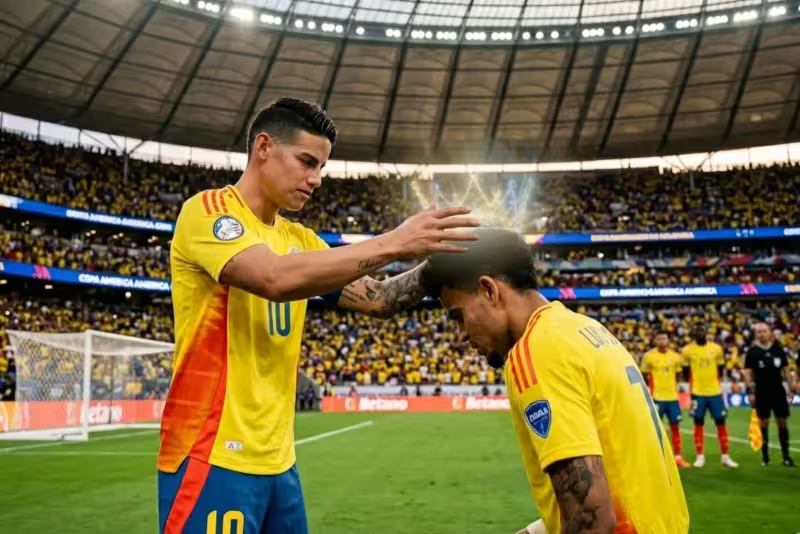
When Luis Diaz reached out his hand and pretended to place an invisible crown on James Rodríguez’s head after a penalty in Colombia’s 5-0 win over Panama on July 6, 2024, the moment read like a public anointing. Less than a year later, on June 10, 2025, at the Monumental Stadium in Buenos Aires, Rodríguez returned the gesture after Díaz’s goal against Argentina. The two acts — staged in a Copa America quarterfinal in Glendale and an away World Cup qualifier in Buenos Aires — are now being treated as a deliberate, shared transfer of leadership inside Colombia’s squad ahead of the 2026 FIFA World Cup.
The exchange matters because of who is involved and what each brings. Díaz is 29 and arrives at the tournament making his World Cup debut after joining Bayern Munich in July 2025 for €75 million; Rodríguez is 34, a global name who won the 2014 World Cup Golden Boot with six goals, two Champions League titles with Real Madrid and two Bundesliga titles during his Bayern Munich years from 2017 to 2019. The gestures link a younger forward whose club value has just peaked with an elder statesman whose résumé is built on singular global moments.

Those credentials give weight to the symbolic handover. Rodríguez has publicly lauded Díaz’s capabilities, saying Díaz ranks among the planet’s most energetic and strongest players, praising his speed and decision-making, and suggesting a deep World Cup run could put Díaz in contention for the Ballon d’Or. That kind of endorsement from a player with Rodríguez’s history turns a stadium stunt into a signal to teammates, fans and opponents alike.
But the picture is not a clean succession. Rodríguez remains a competitive, active professional — he began playing for Minnesota United in MLS in February 2026 — and the gestures read more like a sharing of a spotlight than an abdication. Díaz, for his part, brings recent momentum: he left Porto in 2019, signed with Liverpool in early 2022, and then moved to Bayern; he will be a World Cup rookie in 2026, arriving with club form and a high transfer price but without prior tournament experience at the global finals.
The tension is straightforward and practical. Public gestures can shape locker-room narratives, but leadership’s true test happens under tournament pressure: who carries the team’s tempo, who takes vital set pieces, who steps up when opposition intensity rises. One player’s legacy and another’s upward trajectory can complement one another, or overlapping roles and differing match rhythms can complicate on-field chemistry. The Crown exchanged in front of fans will count for little if minutes, positions and responsibilities are unclear when matches narrow to single-goal margins.
For Díaz, the moment is both an accolade and a responsibility. At 29, his path — Porto to Liverpool to Bayern — has been a steady climb; the World Cup will be the first time he must convert club acclaim and national expectations into performances on football’s biggest stage. For Rodríguez, the gestures allow him to shape Colombia’s narrative without surrendering influence: by publicly elevating Díaz he can coax younger talent into focal roles while preserving the on-pitch authority his experience affords.
What matters next is concrete. The 2026 FIFA World Cup will be where this symbolic crowning either proves prophetic or proves cosmetic. Colombia’s coach will have to translate the duet of gestures into a working plan: distribution of minutes, tactical roles that prevent redundancy, and clear leadership in moments of stress. The tournament will produce the measurable answers — who scores in knockout games, who controls possession against elite opposition, who makes the decisive plays — and with them, a verdict on whether two crowns can sit on one national team without clashing.