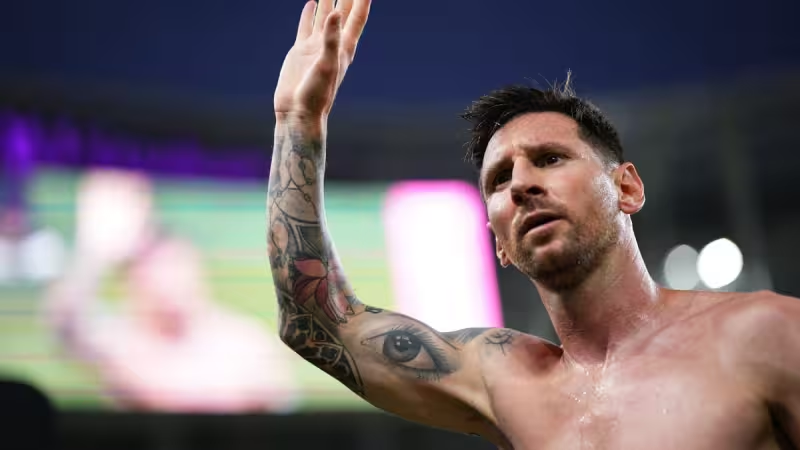
When Lionel Messi walks onto the pitch at Kansas City Stadium on June 16, the number on his back will be obvious; the story written on his skin will be quieter but just as visible. Tattooed across both legs and down his right arm, Messi’s ink reads like a personal ledger — family, faith and a career marked in black and color that millions of fans have learned to read up close.
The sleeve on Messi’s right arm opens with a portrait of Jesus wearing a crown of thorns, a clear signpost of the faith-themed imagery that runs through the work. Around his elbow sits a rose window, likely inspired by Santa Maria del Pi in Barcelona, ringed by flowers and rosary beads; nearby a classic-style pocket watch and other ornamental pieces knit the sleeve together. On his left shoulder blade is a portrait tribute to his mother, Celia, and in 2018 she summed up what that ink means to the family: "Leo is a divine son, a beautiful brother, a better father and an incredible husband,"

Messi’s lower limbs carry a different kind of record. His right lower leg bears the names Thiago, Mateo and Ciro with their birthdates above the ankle; his left lower leg shows a Five of Cups playing card, a soccer ball, the number 10 and the tiny handprints of his oldest child, Thiago. Separately, a large black cover-up dominates the lower left leg, placed over earlier tattoos that included a sword and angel wings — a deliberate erasure that changed the literal surface of his story.


Interwoven through those family markers are other personal touches: rosary beads that trace the outline of his hometown of Rosario, a rose-window motif tied to Barcelona, and a small eye tattoo on the inside of his right bicep that many observers have read as a tribute to his wife, Antonela Roccuzzo. The couple married in 2017, and at least one matching crown tattoo between them is reported — details that underscore how much of Messi’s personal life has been rendered in ink.
That accumulation of images has become familiar not because tattoos ever became fashionable, but because Messi has spent two decades making them visible on the world’s biggest stages. The left-leg sleeve and the right-arm sleeve are the most noticeable elements; when the shorts and sleeves come up or down during international matches, viewers get a concentrated, repeatable snapshot of pieces that once required close inspection.
Not every mark carries the same certainty. Some designs are unmistakable decisions — the bold black cover-up that replaced a sword and wings, the names and birthdates inked beside an ankle. Other meanings have been supplied by observers and by the patterns fans and reporters recognize: an eye read as an Antonela tribute, a rose window linked to a Barcelona basilica. Those later interpretations sit beside deliberate choices, and the line between what Messi asked the artist to do and what others later inferred is not always clear.
The practical consequence is simple: some of Messi’s ink is intentional biography, and some of it is public interpretation. The single most consequential unanswered question now is which of the visible pieces were chosen by Messi to say exactly what they appear to say, and which became shorthand for a story fans wanted to believe. He will carry those images into a match against Algeria on June 16; whatever answers they hold, the decision to cover, to name and to portrait is already a form of storytelling only Messi himself can fully explain.