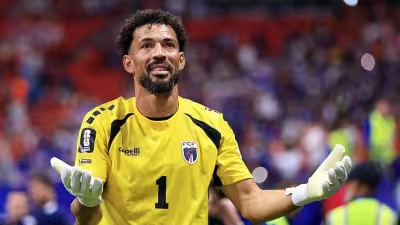
Uruguay landed in the south of Florida on Sunday night after a flight from Cancún was held up for a couple of hours, putting the nation's players and staff on a tighter schedule ahead of their Group H opener against Saudi Arabia.
The delay, FIFA said, was caused by an error with the airline's permits in Mexico; the governing body added that the carrier had apologized and that FIFA remained in close contact with the team while working with airport and operational partners to accelerate the process and limit disruption.

The timing matters: Uruguay trained in Cancún on Sunday morning and were due to play Saudi Arabia on Monday night at Hard Rock Stadium in Miami Gardens. The team arrived late enough Sunday that coach Marcelo Bielsa and defender José María Giménez spoke to reporters at the stadium that night rather than holding public activities earlier in the day.
Bielsa told reporters the flight issue did not create any complication, a terse assessment repeated at the stadium, and Giménez joined him in addressing questions about travel and preparation. Still, FIFA’s account — explicitly citing a permits error and an airline apology — frames the hold-up as an operational failure that had to be managed by tournament officials and airport partners.



This World Cup is being staged across 16 venues and, in its expanded 48-team format, has added layers of logistics to every delegation’s travel. With matches densely scheduled at each site, even a delay of a couple of hours can compress recovery and tactical routines on the eve of a first match — especially for a country that trained the same morning in Cancún.
The practical effect on Uruguay’s pre-match routine is the central unresolved question. FIFA described how it intervened to speed up clearance and limit disruption; Bielsa said the team was unaffected. The two statements sit uneasily together: one frames the incident as a logistical error requiring external help, the other as a non-event for the squad’s preparations.
Beyond those competing accounts, the concrete timeline is thin. Officials say the departure was delayed a couple of hours in Mexico; what is not specified is how much of that time sliced into the squad’s recovery window, meetings and sleep before kick-off Monday night. Those lost hours are the detail that will determine whether the delay was an annoyance or a competitive hindrance.
For soccer fans and bettors, the immediate takeaway is simple: Uruguay is in Miami and available to face Saudi Arabia at Hard Rock Stadium on Monday night. For coaches, players and medical staff, the question will be whether any lingering effects from the day’s travel show up in training, team sheets or late fitness calls ahead of kickoff.
The most consequential unanswered point now is quantifiable: how many hours of planned preparation did Uruguay effectively lose, and did FIFA’s interventions restore enough time and routine to match what the team would have had without the permits error? That measurement — not the apology or the assurance that all went smoothly — will matter when the game begins.