



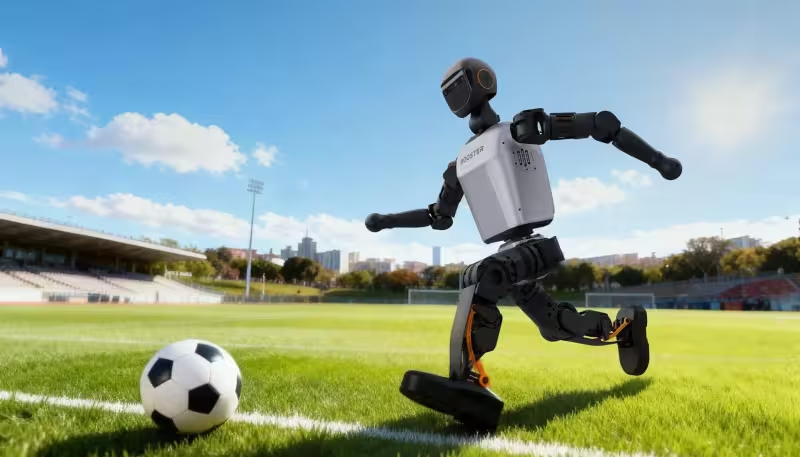
Booster Robotics released footage this week showing its prototype humanoid, the Booster T2, executing penalty kicks strong enough to burst a ball and knock a hole in a wall, with a readout in one clip registering the shot at 62 mph (100 km/h).
The clips are brief and dramatic: a penalty shootout setup, a mechanical leg swing, then a torn ball in one video and visible masonry damage in another. Booster’s on-screen telemetry showed 62 mph in the burst-ball clip, and company material accompanying the footage says the robot was not at full power during that demonstration.

Put plainly: the T2 in the footage delivered at least 62 mph and measurable destructive force. For context, the fastest human free kick on record reached 131 mph (210.8 km/h), set by Ronny Heberson in 2006. The T2’s shot falls well below that human record but is still far above what casual humanoid demos have commonly shown, and the visible damage gives a concrete sense of how much force these systems can now produce.
That matters today because RoboCup 2026 — the international robotics competition that runs annually and trains machines to play soccer with increasing realism — opens in Incheon, South Korea on June 30. Booster’s T1 and K1 platforms are already on the RoboCup roster, and Booster says more than 50 research teams and institutes use its T1. A robot built on the T1 helped a team from China’s Agricultural University win the adult-size category in 2025, and the company’s new T2 footage arrives as teams tune machines for athletic tasks the competition is emphasizing.
Booster Robotics is a Beijing-based company; its earlier T1 stands about 3 feet, 10 inches tall, weighs roughly 66 pounds, and — the company says — offers 23 to 41 degrees of freedom depending on configuration, with about two hours of walking on a charge and four hours standing. The T2 footage sketches the next step of that platform family: more powerful leg actuation and a level of ball impact that teams must now account for in design and strategy.
Still, the most important detail the footage leaves out is what engineers and opponents most want to know: technical specifications. Booster has not published the T2’s torque figures, motor types, actuator architecture, mass distribution, or safety limits. The robot’s kicks were strong enough to do real damage in a controlled demo, yet the company has not released numbers that explain how or why the damage occurred. That gap complicates any straightforward assessment of capability and risk.
The missing specs create two practical problems for RoboCup participants and organizers. First, referees and engineers rely on published figures to calibrate field materials, protective barriers, and safety procedures; visible destruction on a practice wall is a proof point, but it doesn't say how the robot would behave in a contested close-contact play. Second, competitors who adapt to a new baseline of leg power will want to know whether the T2’s performance is repeatable under competition rules, or a calibrated demo shot.
The T2 footage also reframes the public picture of where robot development sits. Names like Boston Dynamics shaped expectations about dynamic mobility and balance, but the T2 clips underscore a different axis of advance: raw kicking force applied by humanoid legs. That matters for RoboCup’s long-term objective of building a robot team that could one day challenge human world champions by 2050; power, not just balance or perception, is now moving the timeline.
The immediate next marker is RoboCup 2026 in Incheon from June 30 to July 6. Teams will bring T1- and K1-based entries and watch new prototypes like the T2 closely. The most consequential unanswered question after Booster’s footage is not whether the clips are real — they are — but whether Booster will publish the T2’s technical specifications and safety constraints before the tournament. That disclosure will determine how organizers set rules and how rivals design responses: without it, the competition gains spectacle but loses the measurable baseline the sport needs to evolve safely and fairly.



