



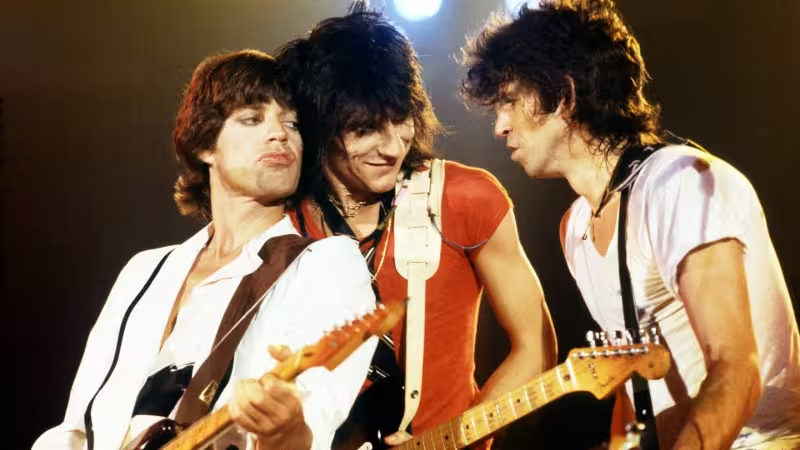
“Live With Me was the very first track I ever played on,” Mick Taylor recalled of the night he stepped into one of rock’s most watched lineups. He was 20 when John Mayall recommended him to the Rolling Stones, and on June 13, 1969 the band staged a Hyde Park press conference and free concert that doubled as Taylor’s public debut.
The scale was immediate: an estimated 250,000 people gathered in Hyde Park, London, to see the band introduce their newest member. Taylor’s audition had impressed Mick Jagger and Keith Richards — the young guitarist's first live contribution that night reinforced what the press conference announced: a new face onstage and, the band said, a new chapter.

Taylor framed the moment in plain terms. Working with the Stones felt “special,” he said, calling it “a new beginning” and “a new phase in their career, a new chapter.” He remembered the roaming experimentation of youth — “We were all a lot younger then and you'd try different things,” — and the wide-eyed sense that the group had shifted direction the instant he joined.
Behind the celebration was a harder reality. The Stones needed a guitarist in 1969 because Brian Jones was struggling with severe drug dependency, a problem that had already hollowed out his role in the band. The press conference and the crowd at Hyde Park offered a public reset even as Jones’s personal collapse supplied the vacancy Taylor filled; the happy picture presented onstage masked the internal disruption that made the change necessary.

That disruption followed a long, public trajectory: Mick Jagger and Keith Richards had first played together at The Marquee Club on July 12, 1962, before the band grew into the huge draw that could fill Hyde Park. Their debut show had been intimate by comparison — about 110 people watched a 50-minute set that closed with an Elmore James number — and Charlie Watts stood in the audience that night before joining the lineup. By 1969 the Stones were playing to hundreds of thousands; the Hyde Park concert marked both continuity and a sharp reset.
The immediate story is straightforward. Taylor had been in John Mayall & the Bluesbreakers; Mayall recommended him; he played a Stones song in audition and impressed; the band introduced him to a massive public audience on June 13, 1969. He later described that first session with the Stones as the very first track he ever played on with them, and the band presented it as the start of a new phase.
The tension that followed — celebrated debut versus the private decline of a founding member — leaves the narrative incomplete. What the record supplied is the personnel change and the public moment; what remains under-explained is how, precisely, Taylor’s presence changed the band’s sound and studio approach. The facts confirm his arrival and his exit — he left the Stones in 1974 — but they do not map the musical turns between those dates in detail.
On this anniversary the practical arc is clear: 57 years ago Taylor was introduced to a quarter-million people in Hyde Park and told the world he felt the band was entering “a new beginning.” He stayed through the next five years and departed in 1974. What listeners and historians still have to sort out is the measure of his musical imprint between those bookends — a question the moment of his arrival made urgent, even as the band put on a celebratory face that June afternoon.



