
"I had moved to Boston and was living a much quieter life," Gisele Bündchen told readers while reflecting on her 2007 W Magazine cover shoot, offering a rare public window into the years she spent in the city during Tom Brady's rise with the New England Patriots.
Her line is small and plain, but it carries weight because Bündchen has rarely discussed that chapter of her life since her 2022 divorce from Brady. The moment she names—Boston, quieter—threads through several of her other remarks: "Earlier in my career, everything was about achievement and saying yes to every opportunity," she said, and "Over time, I began to understand the importance of finding balance."

Those two anchors—time and place—are easy to pin down. Brady and Bündchen began dating in 2007; they married in 2009 and remained together until 2022. Bündchen's move to Boston coincided with Brady's years as quarterback for the New England Patriots, and she frames that relocation as more than a change of address. "My spiritual practice helped me become more present and more connected to myself," she said, adding that "Instead of focusing on external expectations, I started paying attention to how I felt internally."
The sequence she describes—achievement, retreat, internal attention—explains why her reflection matters today. As a public figure who built a brand on global runway work and nonstop opportunity, Bündchen's acknowledgment that she reshaped priorities while living in Boston reframes a well-known public marriage as also a personal turning point. "That changed everything—not only my work, but also the way I experienced life," she said, summing up how those years altered her approach.


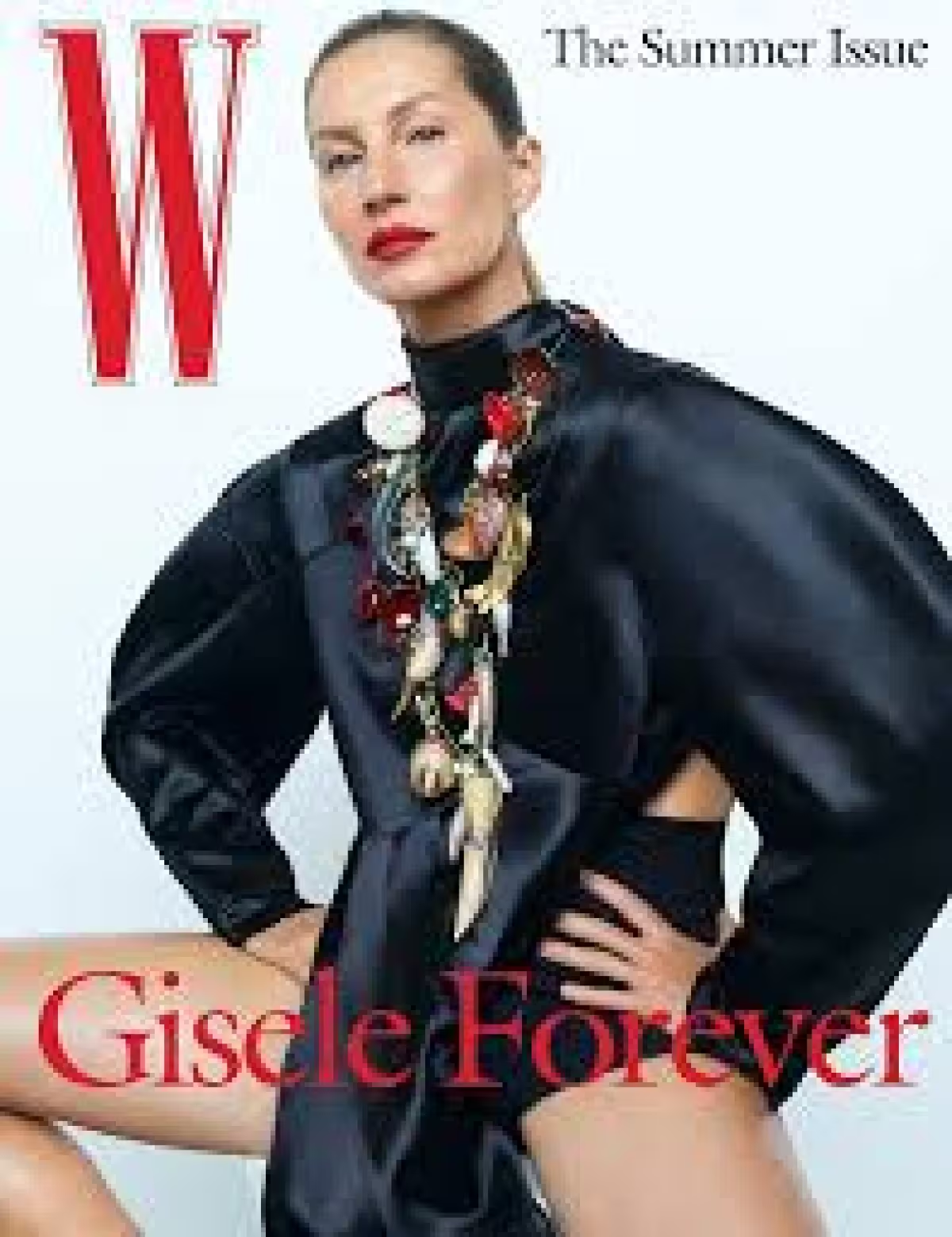
Context sharpens the contrast. Bündchen lived in Boston during the period when Brady was the Patriots' franchise quarterback, a time defined in sports pages by championship runs and in celebrity pages by a high-profile couple. Yet she describes her own experience in domestic terms: quieter, more present, more attuned to balance and spiritual practice. Those are not details her public résumé would have predicted in 2007, and they are the details she chose to emphasize now.
The account contains a built-in tension. Bündchen has not spoken much about their marriage since the divorce, and these remarks are notable precisely because they stop short of turning private history into public exposition. She offers the frame—Boston, spiritual practice, a move away from external expectation—but does not unpack the day-to-day mechanics of that quieter life: what routines changed, who kept what household rhythms, or how parenthood fit into the picture while she lived in the city.
Readers who want specifics about how Boston altered her daily routines will find only the broader arc she provides. Still, what she did offer maps clearly onto her subsequent choices: a shift from achievement-first decision-making to one informed by balance and presence. That trajectory carries forward to her current life—Bündchen is now married to Joaquim Valente, and the couple had a child together in 2025—so the Boston years read as a hinge between two public chapters.
Her remarks arrive as a personal, not a forensic, account. She named the change and the practices that accompanied it, and she left the particulars private. There is no indication of further public commentary about her marriage, and no new events tied to these reflections have been announced. For now, Bündchen has offered a succinct portrait: a move to Boston that quieted the noise, a turn toward spiritual practice and inner listening, and a consequence she describes bluntly—"That changed everything."