



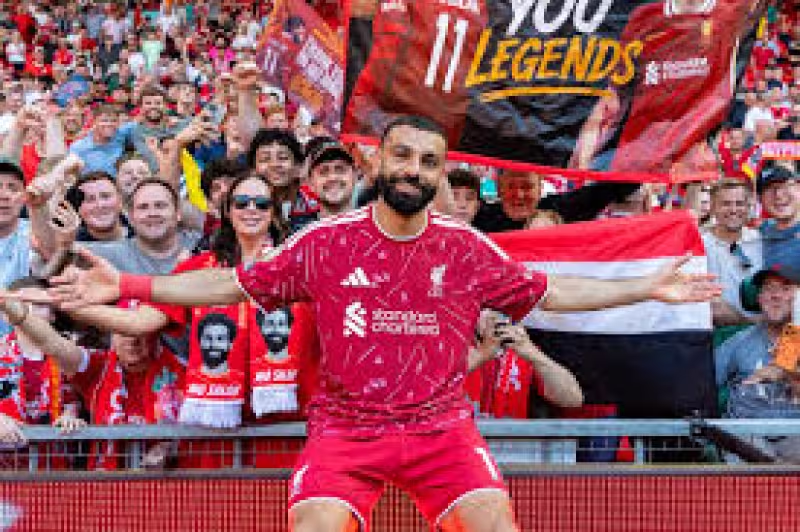
Dejan Lovren, the former Liverpool centre‑back, said bluntly that “The way Mohamed Salah has been treated this season is not harsh... It's disgusting. There are many other problems at Liverpool” and added that Salah “would have definitely stayed at Liverpool if Arne Slot had been sacked earlier.”
Lovren’s intervention lands on two sharp facts from the season: Mohamed Salah scored only 7 goals and had a public clash with Arne Slot, then announced he would leave Liverpool a year before his contract expired. Those three developments — the dip in output, the row with Slot and the early announcement — have dominated criticism of Salah in the past months.

Lovren does not frame the debate as statistical alone. He accused television pundits, including former players, of making Salah a scapegoat for wider problems at the club and singled out Jamie Carragher by name. “Carragher has also spoken badly about me, but he never said it to me directly. You know, he only acts on television and gets paid for it, so he has to act that way,” Lovren said, forcing attention back onto how critics deliver their verdicts as much as the verdict itself.
Beyond the punditry, Lovren places responsibility squarely on the manager. “I don't think it's the board (the one that pressured Salah to leave). I think it's just one person, and I think it's the manager,” he said, and later added, “They did not have a good relationship. Let's put it that simply.” That is a clear accusation: not an institutional decision but a personal breakdown between player and coach, Lovren says, that changed the course of Salah’s time at the club.


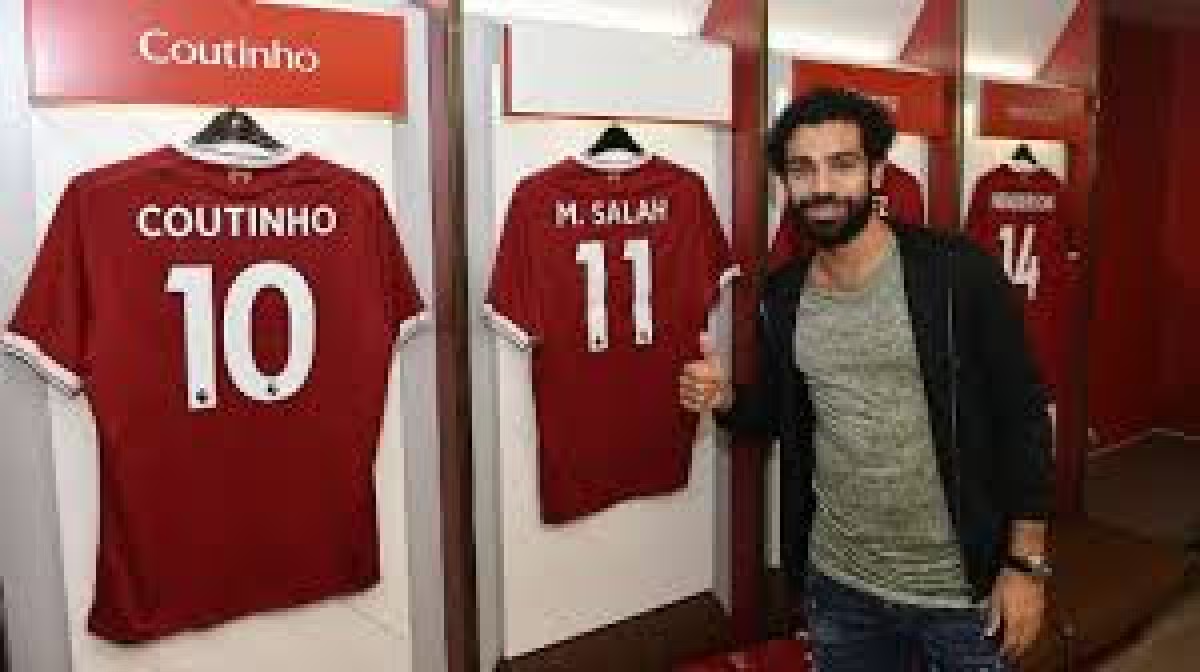
Lovren also returned to what he described as the human side of the story. “Mohamed Salah is a really good guy, with a brilliant mind and a big heart. Honestly, I don't understand it,” he said, stressing the contrast between the player’s character and the treatment he has received. Lovren noted Salah’s previous relationship with Jürgen Klopp as a counterpoint, implying that the player’s standing at the club once rested on a different personal chemistry.
Context matters here: Lovren was at Liverpool from 2014 to 2020 and has continued to speak as someone familiar with the club’s dressing room dynamics; he is currently playing for PAOK this season. His defence of Salah is not abstract — it comes from a former colleague’s perspective on how personalities and power fit inside a modern club.
The friction in Lovren’s account is twofold. He accuses pundits of manufacturing a scapegoat and blames a single managerial figure for pushing Salah away. That leaves an unresolved, consequential gap: who actually made the decisive call? Lovren says it was the manager, not the board, and that Salah and Arne Slot “did not have a good relationship,” but he stops short of producing documentary proof. The allegation reframes a transfer and a season as a failure of relationship management rather than simply tactic, fitness, or form.
Lovren’s remarks sharpen a question Liverpool now faces publicly: will someone inside the club answer them? His charge that Mo Salah was mistreated and effectively steered out by a manager is specific and personal. Whether Liverpool, Arne Slot or Mohamed Salah respond is not confirmed; what matters is that Lovren has put the accusation where it cannot be easily ignored, and the club must decide whether to rebut, explain or let the claim stand unanswered.



