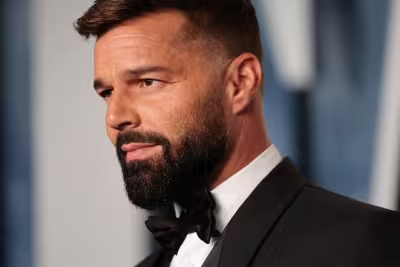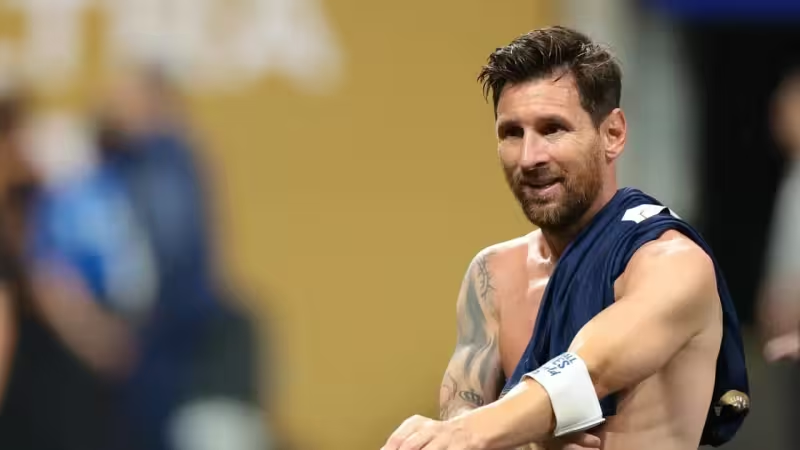
Lionel Messi will be 39 at the 2026 World Cup and Cristiano Ronaldo will celebrate his 41st birthday as the tournament arrives in the United States, Canada and Mexico, and both players rely on disciplined training, recovery and nutrition to blunt the effects of aging.
The blunt numbers explain why teams and fans track those routines: muscle strength and muscle quality begin to fall in the fourth decade of life, fast‑twitch fibers — the ones that power sharp sprints and sudden changes of direction — are affected first, and the body’s ability to use oxygen starts a slow decline from about age 30 while maximum heart rate drops with it.

To meet those biological headwinds, their programs emphasize two overlapping strategies the way sports scientists recommend: targeted resistance work at least twice a week to preserve muscle, and interval training that mixes short bursts of high intensity with controlled recovery. Both approaches show up in descriptions of how the two prepare — precise loads in the gym, measured bursts on the pitch, and strict attention to sleep and recovery protocols.
Those prescriptions are not theoretical. As bodies enter their late 30s and early 40s, recovery takes longer than it did at 20, and older athletes need a stronger training stimulus plus more high‑quality protein to rebuild and maintain muscle. The routines used by Messi and Ronaldo reflect that: they raise the training stimulus, monitor recovery closely and treat rest and nutrition as fixed parts of the workweek, not optional extras.
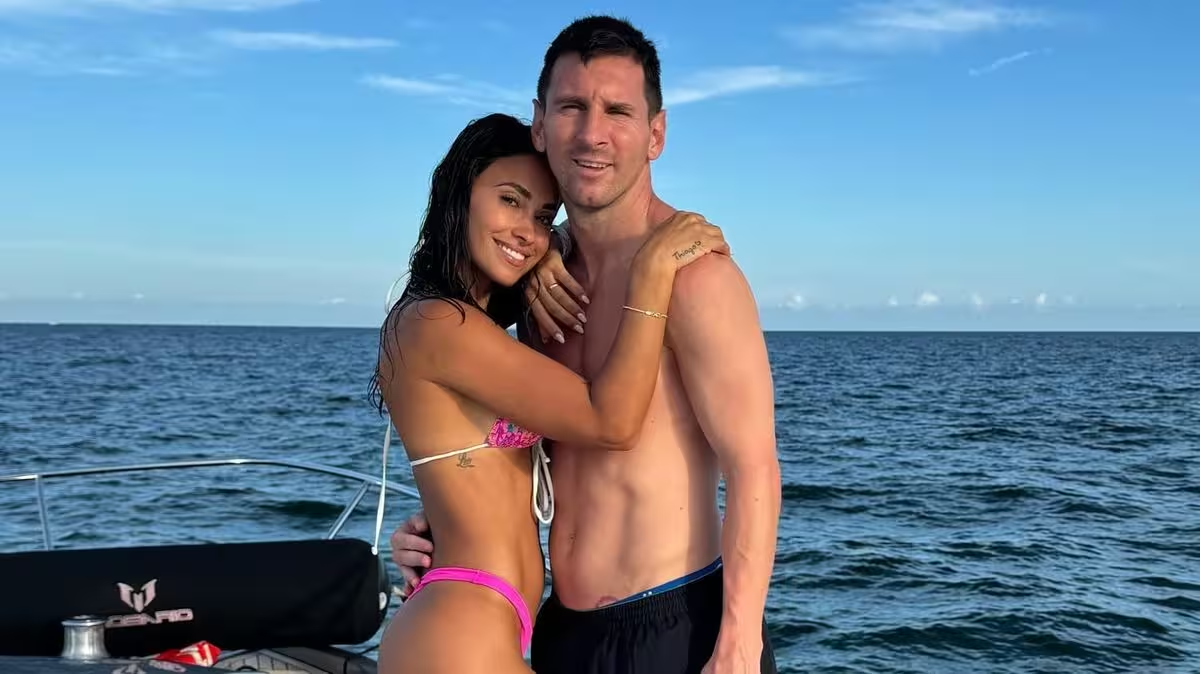

The practical, person-level changes are visible in Messi’s case: his diet was reworked after 2014 by nutritionist Giuliano Poser, earlier chocolate- and soda‑heavy meals left him feeling sick on the field in 2018, and his meal plans by 2025 leaned heavily on biometric feedback. He has also made hydration and routine a public habit — in 2019 Messi said, "I like a hot and bitter mate. I used to drink it sweet, but then I got used to the bitterness and I drink it like that." Media reports also record a growth hormone diagnosis and treatment financed by FC Barcelona earlier in his career, part of a long arc of medical and nutritional intervention.
The friction is unavoidable: both players are routinely described as remaining elite, but neither is at the physical peak they enjoyed a decade ago. Elite performance and peak physiology are not identical; disciplined training, recovery and nutrition compress the decline and preserve decision‑making, positioning and technical skills, while age erodes raw speed and top‑end power. That gap — elite versus peak — is the story’s essential tension.
For coaches and athletes watching, the immediate consequence is tactical: older superstars can still influence games if their minutes and roles are managed around recovery and load. For the players themselves, the calculus is one of durability — how to convert high‑quality training and nutrition into enough matches at tournament intensity to matter.
The unresolved, and most consequential, question is quantifiable: how much measurable career extension do these specific routines buy compared with what other elite players do? The work outlined above makes it plausible that both will be match‑ready at 39 and 41, but it does not — and cannot from training descriptions alone — prove they will reproduce the on‑field influence of their primes. The 2026 World Cup will be the clearest test of how far disciplined preparation can push the limits of age.