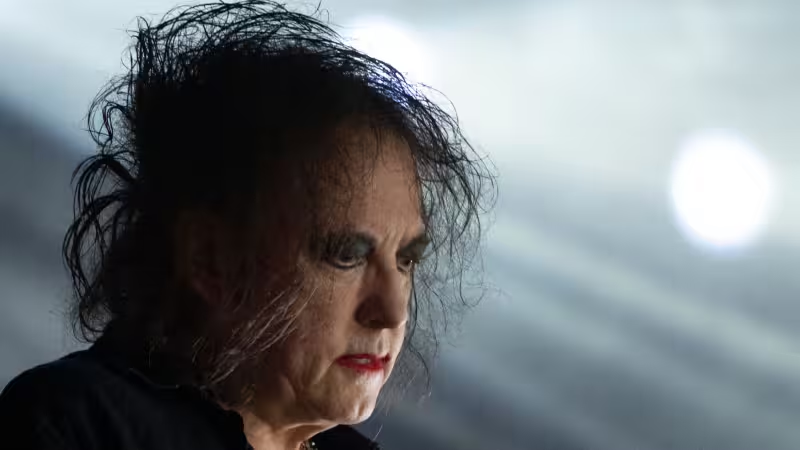
If you are asking who is Robert Smith, listen to what he told 6 Music on June 8: “We did record three albums' worth of songs. So the second one's done. So that's about to be delivered to Universal.” The statement came after The Cure’s return to live performance last weekend at Primavera Sound, and it is the clearest update yet on new material recorded since the band began work on Songs Of A Lost World in 2019.
Smith did not simply announce delivery; he sketched the shape of what’s coming. He said the third album born from the same sessions is “really, really upbeat. It's really poppy,” a blunt description that sits uneasily alongside his next line: “But the next one, if anything, it's more dismal than Songs Of A Lost World.” He added, almost apologetically, “I mean, ‘dismal’, that's a horrible word to use! But it's quite dark emotionally.”

The contrast is central to Smith’s portrait in this moment: an artist who can call melody “poppy” while insisting the emotional core is heavier than listeners might expect. He framed the third record as connected to Songs Of A Lost World but offering “a different perspective on things,” suggesting continuity rather than a course change — and leaving the precise emotional balance to be discovered when the music is released.
Smith revealed the timeline that matters now: initial recordings began in 2019, the band completed material spanning three albums, and the second of those is finished and heading to the major label he named. He also reminded listeners why the band’s output can feel slow and deliberate — “it took me 16 years to get the last album done!” — a confession that casts the delivery-to-release gap as a deliberate process rather than an accident.
His weekend at Primavera Sound underlined how those studio sessions are feeding real-time collaborations. Smith made a surprise guest appearance during Olivia Rodrigo’s set and together they debuted a new song, What’s Wrong With Me. “So I did the song with her, but I didn’t really expect to be singing it live,” he said, and praised Rodrigo: “She’s so good. She is genuinely fantastic as a songwriter, a singer and as a performer.”
Smith used Rodrigo to make a point about generational differences in craft. “It’s probably 20 BPM slower than anything she does,” he said of the collaboration, and later: “It’s not really comparable to how I do things. It’s partly an age thing… At 23 you’ve got a lot more energy than someone of my age.” The contrast was wry — he said he still agonises over songs while younger writers “bang out songs” — and he returned to the long arc of his own process: “it took me 16 years to get the last album done!”
The remarks leave an obvious tension: Smith calls the third record both poppy and emotionally dark. That friction is not a contradiction so much as a promise of complexity — bright surfaces over a somber core. He tied that complexity back to Songs Of A Lost World, saying the new work is related but offers another viewpoint rather than repeating the same musical sentence.
What happens next is concrete and what remains open is distinct. The immediate next step is administrative: the second album is “about to be delivered to Universal,” which is the clearest milestone Smith announced. He did not attach a release date or a rollout plan. For fans and observers the real question is no longer whether new material exists — it does — but when Universal and the band will turn finished masters into a release schedule.
So, who is Robert Smith today? He is the musician steering a three-album project he began recording in 2019, a collaborator willing to jump onstage with younger peers, and a careful craftsman who says his next record will sound poppy while remaining, paradoxically, darker than what preceded it. The second album is done and en route to a label; the third’s jaunty melodies will arrive with a darker emotional frame — and the moment the public will hear them still depends on a decision that, for now, has not been announced.