



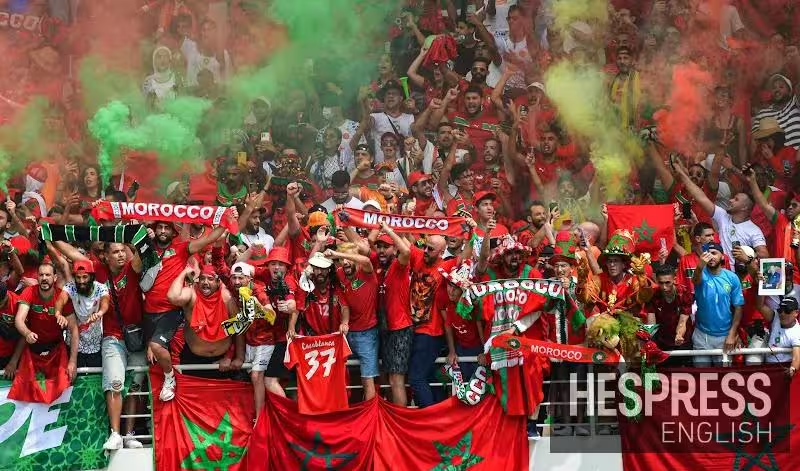
Forty of 42 members of a Moroccan supporters association were denied United States visas ahead of the 2026 World Cup, organizers and fan representatives said, leaving a large portion of an organised fan group stranded after months of planning and spending.
Azzedine Al Attaraoui, who coordinates supporters who have travelled with Morocco to the 2018 and 2022 World Cups and the Paris Olympics, said the refusals came without explanation: "No clear reasons were given for the visa refusals," he said, adding that "We just want to support our national team."

The scale of the financial hit was immediate. Al Attaraoui said some supporters had bought tickets for up to three matches at around $500 each — "totaling $1,500, in addition to visa fees of 1,800 MAD," he said — and others had booked hotels ranging from $400 to $1,000 per night. He estimated some fans had already spent up to 20,000 MAD covering tickets, visas, travel and paperwork. "If they asked for financial guarantees, we would do that," Al Attaraoui said.
The refusals extend beyond that single association. Mourad Hamana said several members of the Sbouaa supporters group were refused US visas and that the knock-on effect hits organisers as well as ordinary fans: nearly 50 group coordinators applied and only six were approved, Hamana said. "To organize thousands of fans, six people is a very small number," he said, and he warned that at least 30 coordinators would be needed to recreate the atmosphere Moroccan supporters have brought to prior tournaments.
Hamana also named the legal basis for many of the denials: several applicants were refused under Section 214, a provision often cited when consular officers decide applicants lack sufficient ties to their home country. The rejection on that ground sits uneasily with Hamana's insistence that "All of us have stable situations in Morocco and no intention of migrating," creating a sharp contradiction at the center of the dispute.
The timing makes the denials acute. The rejections came as supporters had already paid for match tickets, visas and hotels and were finalising travel for games to be played in the United States during the 2026 tournament; organisers say the fans had invested both money and months of logistical work. The group’s history of consistent travel — they attended the 2018 World Cup in Russia, the 2022 World Cup in Qatar and the Paris Olympics — is part of the case they are making to foreign and sporting authorities.
Al Attaraoui publicly asked FIFA to step in and urged Morocco’s Foreign Ministry to help facilitate travel so the fans can support the Atlas Lions at the tournament. Hamana echoed that appeal and called directly on Moroccan Foreign Minister Nasser Bourita to intervene, citing earlier cooperation by Moroccan authorities to secure visas for supporters travelling to Chile for the national U20 team.
For now, however, no intervention or reversal has been confirmed. That gap — whether any of the denied fans will still obtain visas in time for the 2026 World Cup — is the immediate, unresolved question. Fan groups and coordinators say they will pursue diplomatic channels and appeals, but with tournament travel deadlines approaching, the window for remedial action is narrow.
The denials also raise a practical problem for match-day logistics and atmosphere: organisers say that with only a handful of approved coordinators the fans’ ability to move as a coherent and visible group will be severely reduced, and the financial losses for individuals may be unrecoverable. Related tournament coverage and team previews are running alongside this developing visa story (see match previews such as and the friendly coverage at and
What happens next will depend on whether Morocco’s diplomatic channels and FIFA pressure can produce consular re-evaluations or expedited processing. The strongest immediate fact is plain: forty supporters who planned to travel from Casablanca, Marrakech, Fès, Tétouan and elsewhere now lack visas, and dozens more coordinators face curtailed roles. The unresolved question — will those decisions be changed soon enough to save the fans’ trip — stands between a summer of lost support for Morocco and frantic last-minute diplomacy.



