



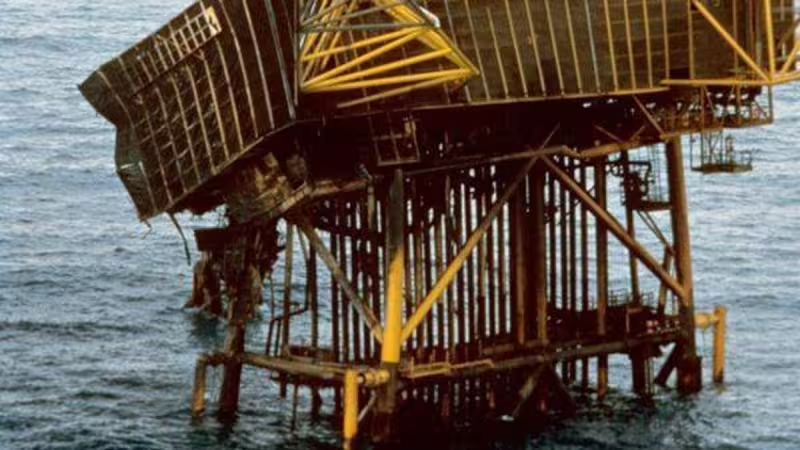
On July 6, 1988 the North Sea oil platform Piper Alpha exploded, setting off a chain of fires and blasts that killed 167 people after no evacuation order was issued and dozens were told to wait for rescue.
Piper Alpha sat roughly halfway between Aberdeen and Bergen and once produced as much as 15.1 million gallons of oil a day, supplying roughly 10 percent of the U.K.'s oil and gas. In the evening shift a routine maintenance error—during work on pump A, a pressure safety valve had been removed and a blind flange fitted without leak testing—left the platform vulnerable. When pump B shut off at 9:45 p.m. and workers restarted pump A, gas condensate escaped through that temporary blind flange; it ignited jet fires that rapidly escalated into a series of explosions.

The human toll was immediate and vast. Jet fires and subsequent blasts weakened the structure so quickly that, in a little more than an hour, the platform began to slide into the sea. The collapse pulled the four‑story accommodation module into the water, killing all 81 workers inside. By morning, three‑quarters of the structure above the waterline had tumbled into the sea; 61 people survived while 167 were killed, leaving Piper Alpha as the deadliest offshore oil rig accident in history.
People on the platform were directed into the canteen and told to wait for rescue instructions even as smoke and flame closed off routes to the lifeboats and helideck. Management was aware that an explosion had occurred but did not halt production and never issued a full evacuation order, a decision that would become the central friction in inquiries and public memory of the disaster.

The mechanism that produced the catastrophe is straightforward in forensic terms: a missing pressure valve, replaced by a blind flange that was not leak‑tested, allowed gas condensate to escape when pump operations changed. The inquiry later found a work permit mix‑up was the proximate cause that led to the missing valve and the cascade of failures that followed. Fuelled by pressurised condensate, the flames could not be brought under control quickly; the fires burned for weeks and required sustained effort to extinguish.
Survivors and observers described the scene as a structural disappearance. "In a few hours, three‑quarters was gone and disappeared," Brian Krause said. "It's kind of like, to some degree, the towers collapsing on 9/11. Such magnificent giant structures that you can't imagine coming down. Within a matter of a few hours, they're gone." The scale of destruction underscored both the human cost—167 dead, 61 survivors—and the industrial stakes: a platform that at its height exported oil along a 128‑mile sub‑sea line and helped power a nation.
The political response was swift. Within a week the Secretary of State for Energy appointed Lord Cullen to lead a public inquiry into the causes and handling of the disaster. Lord Cullen's report, published in November 1990, concluded that the missing pressure valve caused by the permit error had ultimately ended the lives of more than 160 men. The report laid out the technical chain of events and assigned responsibility for the gaps in safety procedures that made them possible.
More practical details emerged in the aftermath: routes to lifeboats and the helideck were rendered inaccessible by smoke and flame, the platform slid into the sea in roughly an hour, and the fire took weeks to douse. On the third anniversary of the disaster Queen Elizabeth II unveiled a memorial at Hazlehead Park in Aberdeen to the men who died, a public acknowledgment of the scale of loss that rippled through coastal communities and the oil industry alike.
What remains unresolved in public accounts is not the mechanical cause—the blind flange and the permit mix‑up—but the decisionmaking on the night itself. Why management, knowing an explosion had occurred, did not halt production or order a full evacuation is not explained in the official findings recounted in later reports. The inquiry answered the question of what failed; it did not fully explain the choices that kept men on the platform as flames spread. That unanswered gap is the single clearest legacy of Piper Alpha: a technical lesson embedded in rules and procedures, shadowed by an operational question that still demands explanation.



