



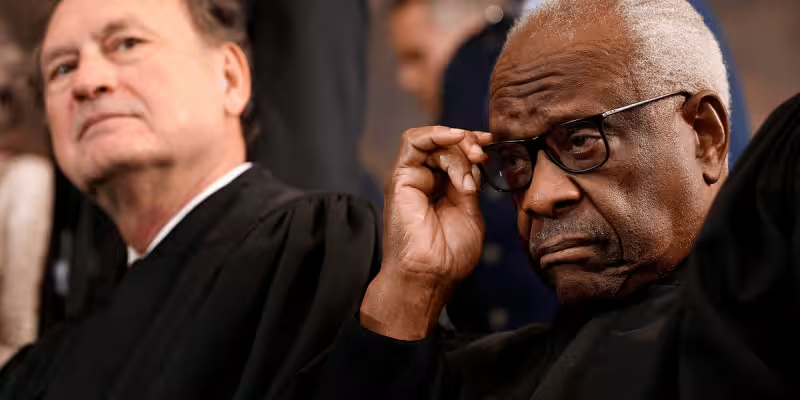
The Trump administration’s Justice Department on Tuesday used Louisiana v. Callais to argue that employment-discrimination law should be read more narrowly, a move that could make it significantly harder for plaintiffs to win in federal court. The opinion came from the Office of Legal Counsel and was signed by T. Elliot Gaiser, who leads that office and once clerked for Justice Samuel Alito.
The connection matters because Callais was not just another voting-rights case. Alito wrote the decision that wiped out a 1982 Voting Rights Act amendment built around a results test, which let plaintiffs challenge state election laws that diminished voting rights because of race without proving racist intent. For 40 years, the Supreme Court had treated that test as a tool that sometimes required states to draw enough legislative districts for Black or Latino voters to elect candidates of choice.

Employment law has its own version of that idea. Congress enacted a 1991 federal law that can let a plaintiff prevail by showing that an employer’s practice has a disparate impact on the basis of race, color, religion, sex or national origin, even when there is no proof of intentional bias. Civil-rights lawyers have long treated that framework as one of the few ways to challenge policies that appear neutral on paper but hit some workers harder in practice.

The new opinion pushes against that understanding by borrowing the same judicial logic that made Callais so consequential in voting rights. In that case, white Southern Republican lawmakers were effectively given room to draw maps that would elect white Republicans, so long as they said they were trying to lock Democrats out of power rather than target voters of color. Applied to the workplace, the same approach could leave employers with more room to defend policies that produce racial or other disparities without admitting unlawful intent.
The broader dispute is not really about one statute or one agency memo. It is about who gets to define civil-rights protections that Congress enacted in 1982 and 1991, and whether conservative justices can narrow those protections through interpretation even when lawmakers wrote results-based standards into the law. Ian Millhiser, a legal commentator cited in the coverage, said both the Voting Rights Act’s results test and employment law’s disparate-impact test were enacted by Congress, not invented by judges.
What happens next is whether a Republican-controlled federal judiciary takes the DOJ’s reading and applies Callais to employment cases. If it does, many employment-discrimination plaintiffs could face a much steeper climb in court, and elected officials could lose much of their power to remedy discrimination of all kinds. Trump’s Transportation Department said one day later that it was already applying Callais to its regulations, a sign the administration is testing how far the decision can reach before the courts answer the question for good.



