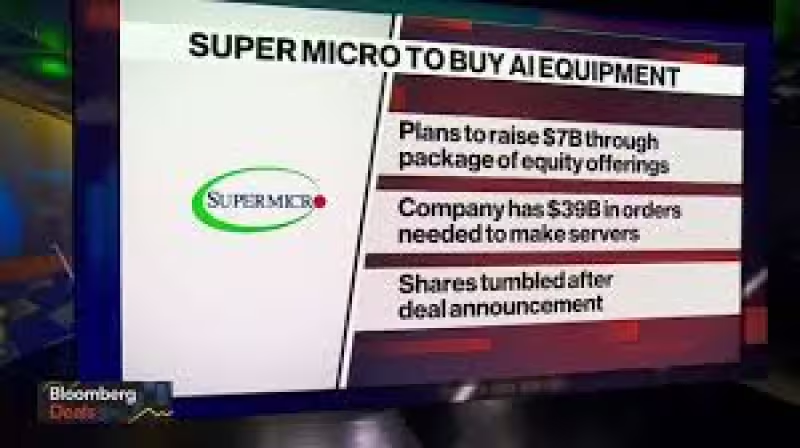
Smci Stock tumbled 19% at the open Wednesday after Supermicro Computer said it plans to raise roughly $7 billion through a mix of equity and equity-linked financing.
The drop followed a 12% slide on Tuesday, leaving shares off sharply over two sessions even though they were still up 13% year to date amid a surge in demand for AI servers. Supermicro said the capital will be used to buy components to fulfill about $39 billion in AI server orders it received in recent weeks — an order book the company called the driver for the fundraise.

$7 billion is large enough to change investor math: it signals the scale of the hardware scramble behind the AI boom while also opening the prospect of meaningful dilution for existing holders. The immediate market reaction — a near one-fifth fall at the open — shows traders are pricing in that tradeoff rather than celebrating the order backlog alone.
Supermicro is now among several tech companies tapping public markets to bankroll AI ambitions. The company’s move comes as other large firms have sought massive equity commitments for infrastructure: Alphabet announced an $80 billion equity raise that was later upsized to $84.75 billion to expand compute and AI infrastructure. Supermicro’s announcement also arrives ahead of several major AI-related IPOs, including companies tied to machine-learning services and satellite-launch infrastructure.



The contrast between the $39 billion in orders and the $7 billion funding target is the story’s central friction. The financing is explicitly aimed at meeting component needs for those orders — a sign of intense, immediate demand — but the company has not disclosed how the equity-linked pieces will be structured or how many new shares might be issued. That gap is what spooked investors: a company selling shares to buy parts for machines it has already booked still may leave current shareholders owning a smaller slice of a much larger pie.
Market activity underlines the uncertainty. Shares had been buoyed by AI spending this year; the two-session decline erased a substantial chunk of that gain. Traders and shareholders will now watch for more detail from the company about timing, pricing and the mix between straight equity and equity-linked securities, since each option carries different dilution and financing risk profiles.
Supermicro’s statement left open the key operational and capital-markets questions: when the financing will close, what the final size and structure will be, and how the company plans to manage the balance between rapid fulfilment of orders and shareholder value. Those answers will determine whether the move is seen as a prudent push to seize a rare market opportunity or as a costly dilution forced by supply-chain timing.
The clearest near-term read for investors is this: Supermicro prioritized locking in components and meeting an unprecedented order backlog over protecting short-term stake percentages. If the company follows through and delivers on the $39 billion in orders, shareholders who accept dilution could own a larger, revenue-generating company; if the financing proves heavier on equity than anticipated or orders slow, the stock could face further pressure. The unresolved question that will move the next market reaction is straightforward — how much dilution will existing shareholders actually face, and when will investors learn the answer?