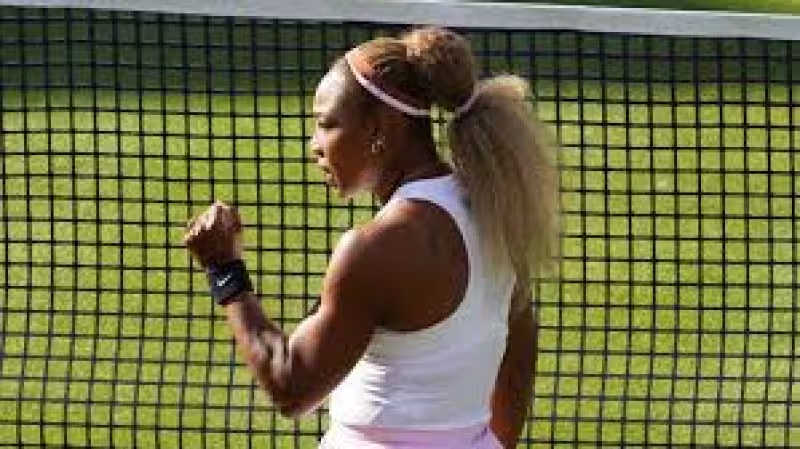
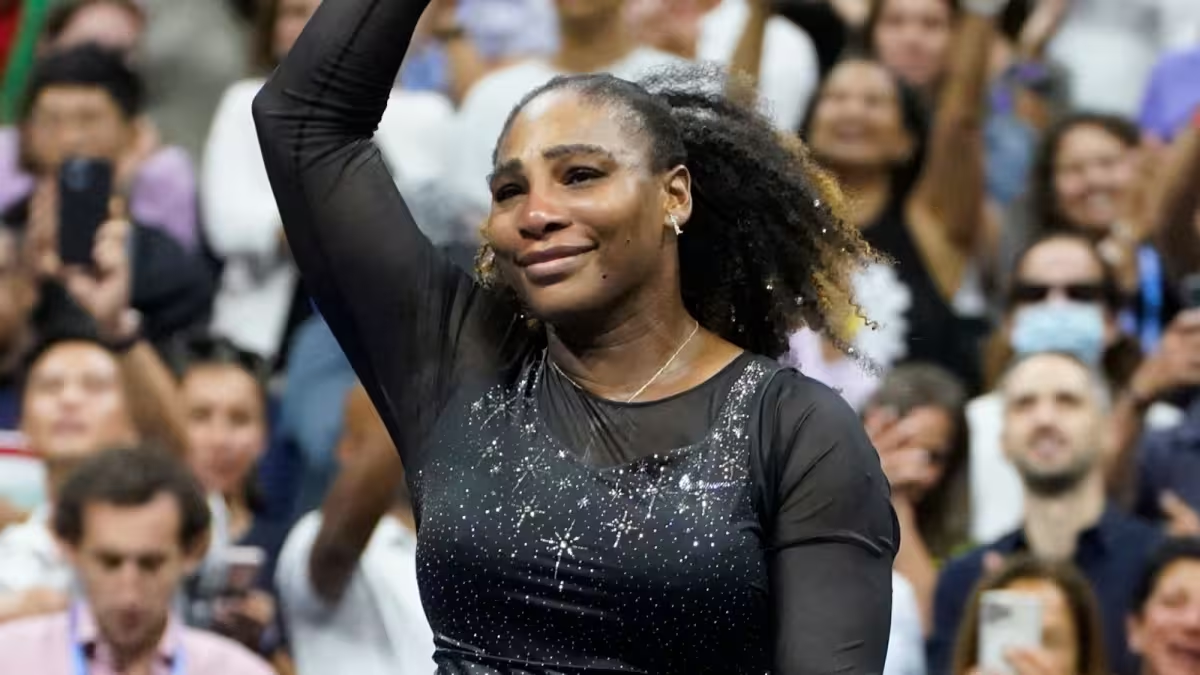
Serena Williams returned to competitive tennis with a straight-sets doubles victory at the Queen’s grass-court tournament in London, teaming with rising Canadian Victoria Mboko to topple the tournament’s No. 3 seeds.
The result marked Williams’s first match win after a long absence; the 44‑year‑old, a 23‑time Grand Slam singles champion who has lifted Wimbledon’s trophy seven times, announced last week she would play doubles at one of the main tuneups ahead of Wimbledon and converted that plan into immediate on‑court success.

The scoreline underlines the outcome: Williams and Mboko advanced in straight sets against higher-seeded opponents, handing the younger pair a notable upset and giving Williams a competitive finish she has not logged on tour in years.
How Williams prepared for this return matters as much as the match itself. Last summer she disclosed that she had been using Zepbound and has spoken publicly about struggling with her weight and resisting an easy fix; she has explained that she turned to medical treatment only after training alone was not producing the results she needed. Williams manages that treatment through Ro, a telehealth company for which she serves as a paid ambassador.
Those details sit alongside the sport’s anti‑doping framework. Semaglutides and tirzepatides—the drug classes that include Zepbound—were placed on the World Anti‑Doping Agency’s monitoring program in 2024. They are not currently listed as prohibited substances and are not classed as performance‑enhancing drugs, and a WADA spokesperson has said there is no timetable for deciding whether the monitoring will lead to policy change.
Governance adds another layer: tennis anti‑doping protocol is administered by the International Tennis Integrity Agency, and as an Olympic sport tennis must follow WADA’s code. That institutional overlap means Williams’s public disclosure, her Ro affiliation and the agency monitoring will figure into any future regulatory reviews—even if, for now, her treatment raises no violation under current rules.
On the court, the practical story remains straightforward. Williams had not competed at this level for years, and winning a doubles match at a principal Wimbledon warmup shows she can still produce match play under pressure. Doubles demands different movement, timing and patterns than singles; translating this victory into a singles campaign would require more matches and a commitment she has not made.
Williams has not directly committed to playing singles yet. That is the clearest consequential gap left by the Queen’s result: if she enters singles competition, this win will read as the opening step of a broader comeback; if she confines her return to doubles and exhibition play, it will stand as a headline moment rather than the start of a new competitive era.
The immediate next development to watch is practical and binary—whether Williams signs on for singles draws at the grass‑court events to come or uses doubles appearances as tuneups and publicity. Her decision will determine whether Saturday’s victory with Victoria Mboko is a one‑off reappearance or the prelude to a full‑scale return to the singles tour.