



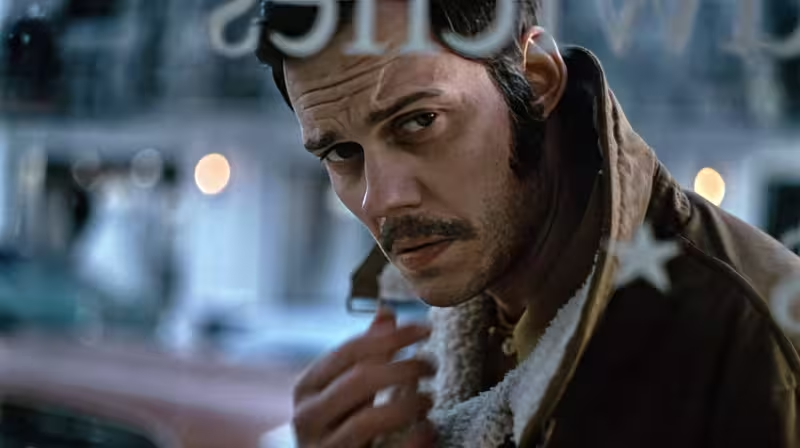
Dead Man’s Wire is now streaming and trending on Netflix, and Bill Skarsgård’s looming, magnetic turn as Tony Kiritsis is the film’s central claim on attention.
Gus Van Sant directed the tightly made dramatization, shot in 19 days, that retells a 1977 Indianapolis hostage incident: Tony Kiritsis abducted the son of a mortgage broker he said had wronged him and looped a short wire attached to a shotgun around the hostage’s neck. Dacre Montgomery plays the hostage, Richard Hall; Colman Domingo appears as radio DJ Fred Temple; Al Pacino is billed as M.L. Hall. The soundtrack leans into the period with needle drops by Deodato, Labi Siffre, Donna Summer and Barry White, and the film feels steeped in 1977 in costume and tone.

The most discomfiting evidence the movie delivers comes after the credits: television footage of the real Kiritsis marching the real Richard Hall down a street with the shotgun pressed to his neck. That archival end‑credit clip, juxtaposed with the stylized reenactment, crystallizes why the film’s arrival on a global streamer matters now — it repeats a raw historic image for millions who had never seen it.
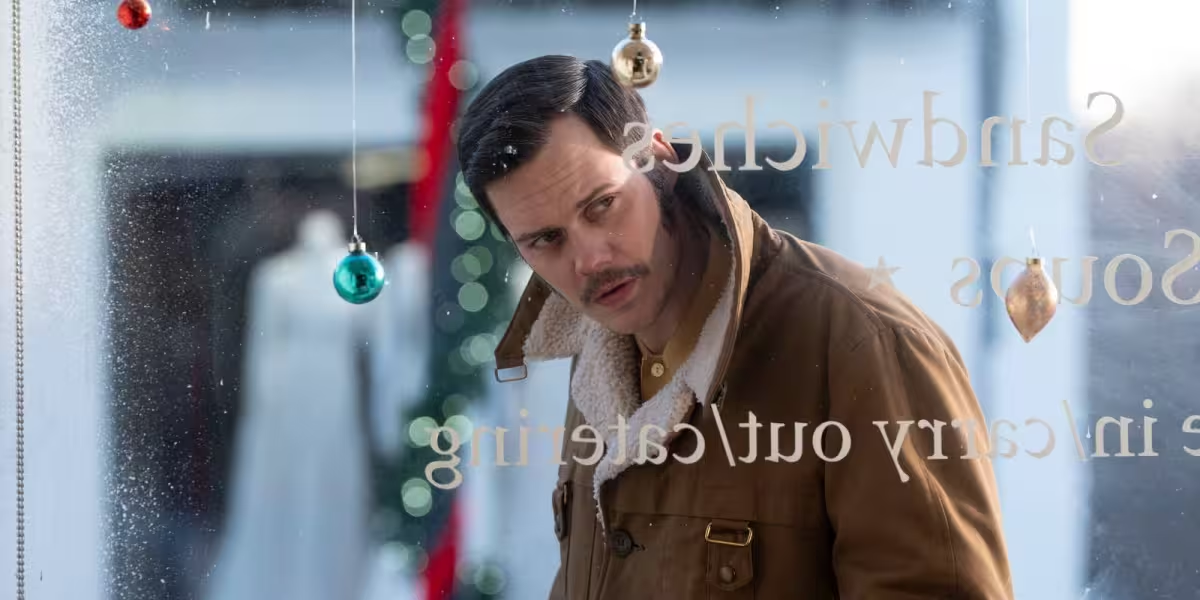
Van Sant’s adaptation keeps the action spare and immediate. Skarsgård’s Kiritsis reads as unassuming and middle‑aged until he snaps, which makes the character’s menace more unsettling than any broad political sermon could be. The production’s short schedule and focused scope give the movie a tautness that foregrounds character and circumstance rather than spectacle.
Yet Dead Man’s Wire carries a friction: it invites political interpretation but stops short of saying anything explicit about the political dimension of the incident. The film reproduces archival proof of real humiliation and threat, and it foregrounds economic grievance — Kiritsis targeted the broker’s son over a mortgage dispute — but it declines to frame the episode as part of a wider social or political argument. That restraint sits oddly beside the decision to show the authentic footage at the end; the documentary‑like proof amplifies stakes while the dramatization withholds judgment.
The creative choice is a deliberate one. Van Sant has long alternated between provocation and cool observation in his work, and here he appears to choose the latter: stage the moment, render the characters, then let the evidence speak. What that means for audiences is immediate and not academic. Netflix’s reach will send the film into living rooms and algorithmic playlists, where viewers will supply context, outrage, or explanation depending on what they bring to it.
With no explicit political line, Dead Man’s Wire hands the question back to the audience: how do you read a 1977 public humiliation and threat when you see both a cinematic reenactment and the raw footage afterward? The movie’s presence on Netflix guarantees the question will be asked again and more loudly than it was 49 years ago; Van Sant’s choice to observe rather than editorialize makes those conversations the next, and likely the most consequential, act.



