



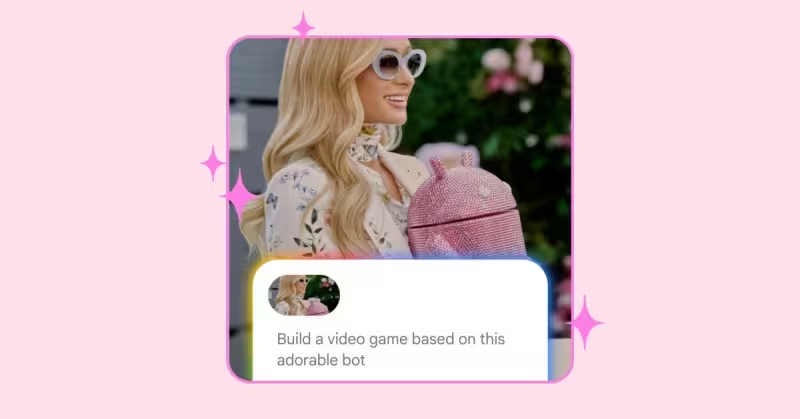
Paris Hilton has spent years imagining apps she could use, but not build. Now Google says she is Android’s first icon in residence, and the partnership is designed to show how its newest AI tools can turn an idea into something real without a coding background.
Hilton said the experience left her feeling like an “undercover nerd,” a label that fits the way Google is presenting the campaign: not as celebrity branding, but as a live demonstration of what Android and Gemini can do for ordinary users. On a landing page tied to the partnership, Google showed off the Android-powered Razr Fold along with Circle to Search, Gemini Canvas and Gemini’s Omni and Nano Banana creative tools.

The centerpiece is a productivity app Hilton built with Gemini Canvas, called Iconic Ideas. She said it took just three prompts before she could already see the app taking shape. “I didn’t have to write code,” Hilton said, adding that she could describe a vision and let Gemini bridge “the gap between the idea in my head and an app I could actually use.”



That matters because Hilton is not presenting herself as someone who had always lived on the technical side of the line. She said she has been an Android user for years, and she also called herself a Motorola user, a pairing that gives the campaign a familiar consumer angle instead of a purely polished promotional one. Google has previously worked with Hilton around the Razr brand, so the new role extends an existing relationship into a broader pitch about app building.
For Google, the real point is bigger than one custom app. The company said the partnership is meant to show what Android’s AI tools can do for real people, and a Google blog post said the role is intended to help more people see themselves as creators of technology, not just consumers of it. The custom Sliv Lab Google built at its campus for Hilton suggests the company wanted the demo to feel hands-on rather than abstract.
There is still a gap between a celebrity demo and a product most users will try on their own. Google has not said how widely it plans to roll out or market Iconic Ideas, or how far it intends to push the broader icon in residence campaign. Even so, the message is clear enough: Google wants the public to look at Gemini Canvas, Circle to Search and its other tools as something closer to a starter kit for building apps than a feature list on a spec sheet.
Hilton’s pitch lands because it sits on both sides of the same story. She says technology does not have to be intimidating, and Google is betting that a simple app made in a few prompts is the best proof of that. What remains is whether the campaign will move beyond one high-profile example and give more users a reason to try building something themselves.



