



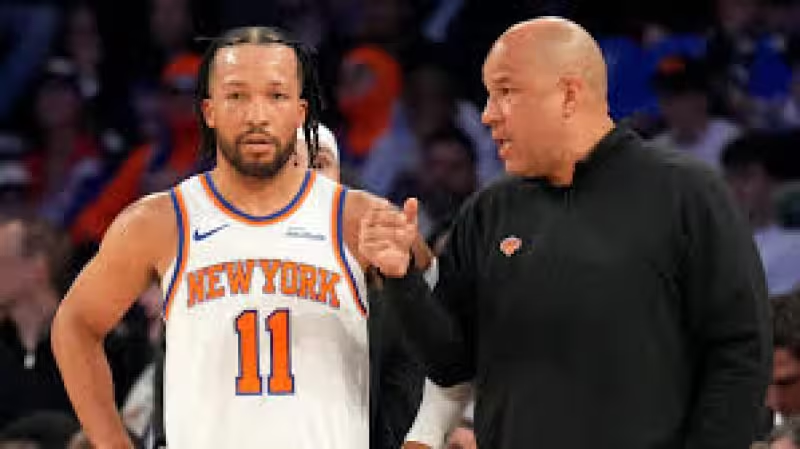
Rick Brunson remembers the call as a joke. "That was a 30-second conversation," he said in 2025, adding that he "wasn't on the phone, but how I got the message was, 'You guys wouldn't be interested in that deal now, would you?' That's how it was said to me. I just laughed."
The reaction matters because, as reported by veteran reporter Marc Stein, Jalen Brunson's representatives literally "laughed" when the Dallas Mavericks circled back offering a four-year, $55.5 million extension — the most Dallas could legally propose ahead of the 2021-22 season. That short, awkward exchange now sits at the center of how Brunson left Dallas and signed a four-year, $104 million deal with the New York Knicks in the summer of 2022.

Those figures give the moment its weight: $55.5 million versus $104 million. The smaller number was what Dallas could have offered before the 2021-22 season; the larger number is the contract Brunson ultimately accepted in New York. Between those two anchors sits a brief phone call and a decision that cost the Mavericks a homegrown backcourt piece.
Timing and engagement deepen the story. In April 2022 reporter Tim MacMahon reported that Dallas never formally offered that extension and did not engage in negotiations with Brunson's representatives. Two months later Brunson left for New York. The collapse between Dallas and Brunson, as Rick Brunson describes it now, was not a long war of attrition but a short, decisive misstep.
There are reasons the Mavericks might have hesitated. Observers have pointed to fit concerns: a backcourt pairing of Brunson and Luka Dončić presents challenges because both are at their most effective when they run the show. Marc Stein has also suggested Dallas could have repaired the relationship by making a blow-away offer above Brunson's market value, an explicit recognition that a measurably bolder bid might have changed the arc.
That suggestion—make an offer that removes doubt—collides with the fact that Dallas either could not or would not make that offer when it counted. The friction is not merely that the club missed a player; it is that the gap between the offer on the table and the contract Brunson later signed is so large that it reframes how the front office's risk calculations will be judged.
Brunson's success in New York, measured by the contract he received and the role he was given, has kept the moment alive. The jalen brunson contract signed in 2022 serves as proof that the market valued him at roughly double what Dallas had signaled it would pay. That numerical disparity is what turns a short phone call into a long-running grievance in Dallas lore.
The unresolved question is simple and sharp: why did the Mavericks delay or avoid a stronger extension offer that might have kept Brunson? There has been no public, granular explanation from Dallas that details whether the limit was financial, philosophical, or a result of concerns about backcourt dynamics with Dončić. Without that accounting, the episode remains a clear missed opportunity and a cautionary note for teams weighing when to bet on promising rotation players.



