



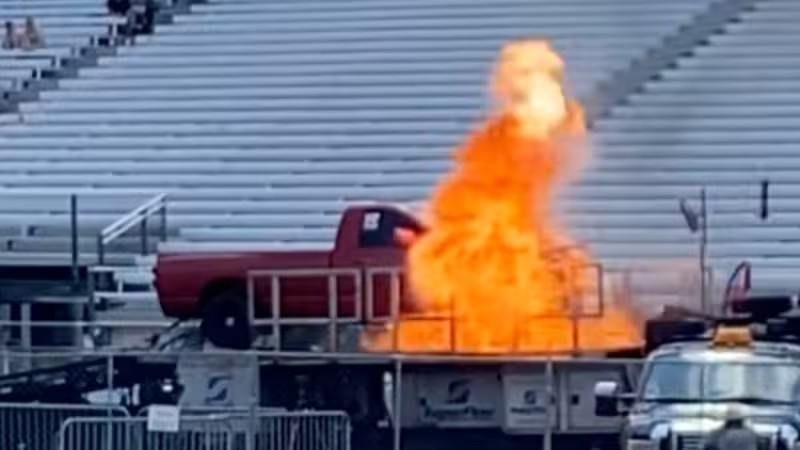
Jake Rodriguez’s third‑generation Ram, running a Cummins powerplant, made 2,695 horsepower on the dyno at the Ultimate Callout Challenge in Indianapolis over the weekend — and then the run ended in an explosion when a nitrous controller failed and the engine blew up.
The output figure is the clearest measure of what the truck was doing moments before failure: 2,695 hp on the rollers, a number that proved the build’s raw capability even as the mechanical failure cut the attempt short. JBJ Diesel, the Idaho shop that prepares Rodriguez’s truck, removed the damaged unit and installed a spare engine so the team could continue into the remaining UCC rounds, which included a sled pull scheduled for the next day.

That swap mattered immediately. With the blown engine sidelined, the spare was the only way Rodriguez and JBJ Diesel could take part in the event’s remaining tests. The team’s ability to mount a competitive sled‑pull run — and to preserve points and reputational momentum — depended on that emergency replacement performing under live conditions the day after the dyno failure.
Context sharpens what the 2,695‑hp number means. Rodriguez’s red single‑cab has cleared the 3,000‑hp mark before; at last year’s Diesels in the Mountains contest the truck hit 3,342 hp. At this same UCC dyno event, other shops have pushed the envelope even higher — Poor Boys Diesel recorded 3,825 hp — a reminder that dyno numbers are both bragging rights and the baseline for competitiveness at these shows.
That background also deepens the sting of the nitrous controller failure. On the rollers the Ram was “performing beautifully” before control electronics failed and the engine tore itself apart; a mechanical or control failure at that stage does more than end a single run, it forces the team to pivot from pursuit to recovery mid‑event. The emergency engine swap gave JBJ Diesel a path back into the competition, but it also removed the team’s chance to capitalize on the 2,695‑hp proof of concept with uninterrupted runs that might have been tuned further for the sled and for event scoring.
Observers noted that the truck will likely return to a dyno for repairs soon and that the team has another year to get ready for UCC 2027. For JBJ Diesel, the immediate calendar is less important than the practical question of whether the spare engine can match the output and reliability needed on event day, and whether the damaged unit can be rebuilt to the same standard before next season.
The practical outcome is straightforward: Rodriguez and his crew moved from a dyno victory march to damage control, installing a spare to stay in the running for the sled pull the next day. The more consequential result is unresolved — the build proved it can make massive power, but a single electronic failure turned that proof into a repair job. JBJ Diesel now has a confirmed 2,695‑hp benchmark and a year to convert those flashes of peak output into a machine that can survive the strain of competition at UCC and beyond.



